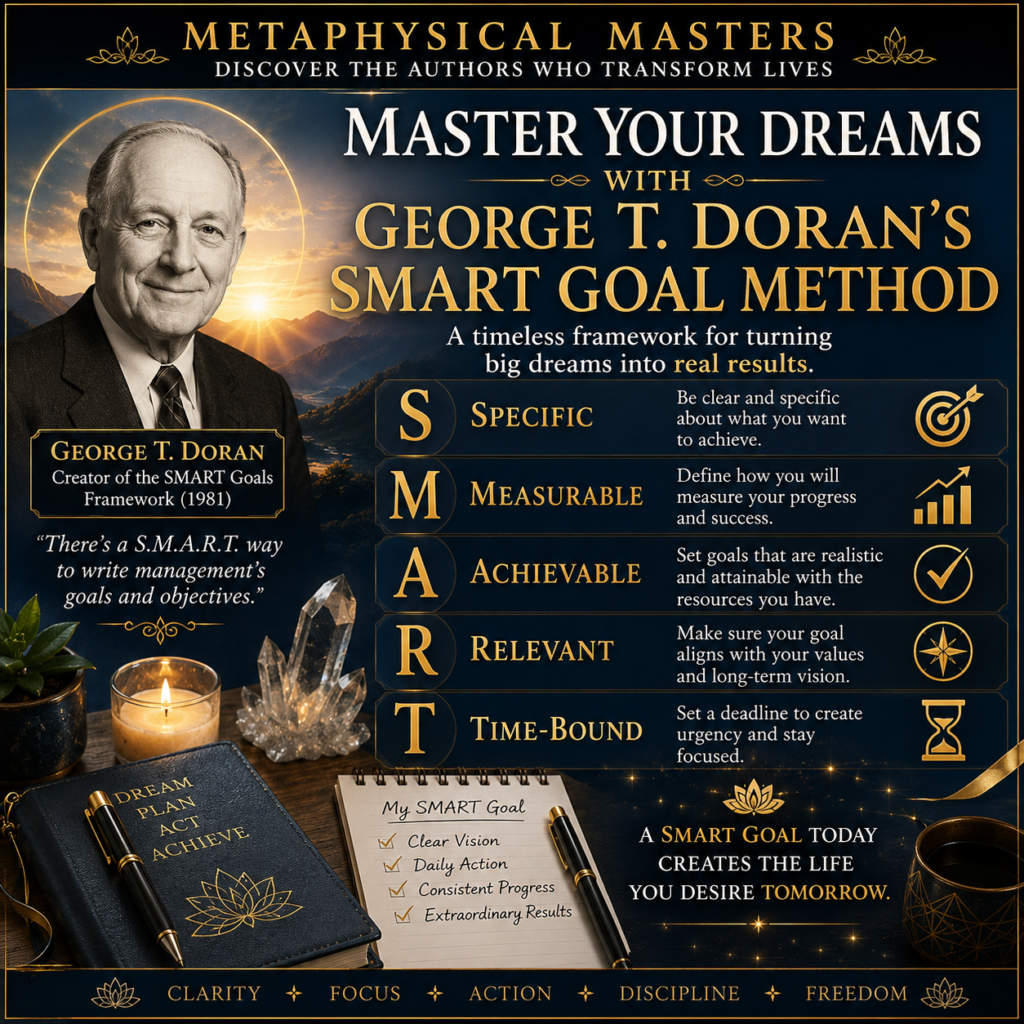
Turn Big Dreams into Real Achievements with a Timeless Goal-Setting Framework
Every great accomplishment begins with a dream—but dreams alone don’t create results. The bridge between vision and achievement is a clear, actionable plan.
In 1981, management consultant George T. Doran introduced a simple yet powerful framework in his article, “There’s a S.M.A.R.T. Way to Write Management’s Goals and Objectives.” More than four decades later, the SMART Goal Method remains one of the world’s most respected systems for setting meaningful, achievable goals.
Whether you’re pursuing financial freedom, improved health, a thriving business, a successful YouTube channel, or greater personal fulfillment, the SMART framework can help you move from wishing to doing.
Who Was George T. Doran?
George T. Doran was a management consultant who recognized that many organizations—and individuals—set goals that were too vague to achieve.
People often said things like:
- “I want to be successful.”
- “I want to lose weight.”
- “I want to make more money.”
- “I want to be happier.”
While these are admirable aspirations, they lack the clarity needed to guide consistent action.
To solve this problem, Doran introduced the SMART framework, encouraging people to create goals that are well-defined, measurable, and realistic.
His idea has since become one of the most widely used goal-setting systems in business, education, coaching, athletics, and personal development.
What Does SMART Mean?
S — Specific
A goal should clearly define exactly what you want to accomplish.
Instead of saying:
“I want to grow my business.”
Try:
“I want to increase my monthly revenue by offering two new digital products.”
The clearer your destination, the easier it becomes to create the path.
M — Measurable
If you can’t measure your progress, it’s difficult to know whether you’re moving forward.
Ask yourself:
- How will I know I’ve succeeded?
- What numbers will I track?
- How often will I measure progress?
Tracking your progress helps maintain motivation and highlights areas for improvement.
A — Achievable
Great goals should challenge you—but they should also remain realistic.
Ask yourself: - Do I have the necessary skills?
- If not, what do I need to learn?
- What resources can help me?
An achievable goal stretches your abilities without becoming discouraging.
R — Relevant
Every goal should align with your larger vision.
Ask: - Does this support the life I want to create?
- Is this worth my time and energy?
- Does it move me closer to my long-term purpose?
When your goals match your values, staying committed becomes much easier.
T — Time-Bound
Without a deadline, goals often remain unfinished.
Setting a completion date creates urgency and encourages consistent action.
For example:
“I will complete my online course within 90 days.”
A timeline transforms intentions into commitments.
Putting SMART into Practice
Imagine your dream is to write a book.
A vague goal might be:
“I want to write a book someday.”
A SMART goal could become:
“I will write a 200-page personal development book by December 31 by writing 500 words every weekday.”
Notice how much easier it is to create a daily plan when the goal is clearly defined.
Why SMART Goals Work
The SMART framework reduces overwhelm by breaking large dreams into manageable steps.
Instead of focusing only on the finish line, you focus on today’s next action.
Small, consistent progress builds momentum.
Momentum builds confidence.
Confidence builds success.
Combining SMART Goals with Mindset
Many people use visualization, affirmations, gratitude, and meditation to cultivate a positive mindset.
These practices can strengthen your focus and motivation, but they become even more effective when paired with a clear plan.
Think of it this way: - Your vision inspires you.
- SMART goals organize your path.
- Daily action moves you forward.
- Consistency produces results.
Mindset and action work best together.
Common Goal-Setting Mistakes
Avoid these common pitfalls: - Setting goals that are too vague.
- Trying to accomplish too many goals at once.
- Never reviewing your progress.
- Quitting after temporary setbacks.
- Focusing only on outcomes instead of daily habits.
Success is rarely about perfection. It’s about persistence.
Create Your First SMART Goal
Take a few minutes today and answer these questions: - What is one goal I truly want to accomplish?
- Why does it matter to me?
- How will I measure success?
- Is it realistic?
- Does it align with my bigger vision?
- When will I complete it?
Write your answers down.
A written goal is far more likely to become a completed goal.
Five SMART Goal Affirmations
Repeat these daily: - I create clear goals that lead me toward success.
- Every day I take meaningful action toward my dreams.
- I remain focused, disciplined, and committed.
- I celebrate every step of my progress.
- My consistent actions create extraordinary results.
George T. Doran’s SMART Goal Method has stood the test of time because it transforms uncertainty into clarity.
Instead of hoping success will happen, you create a roadmap that guides your actions one step at a time.
Dream boldly.
Plan wisely.
Act consistently.
And remember: every extraordinary achievement begins with one clearly defined goal.