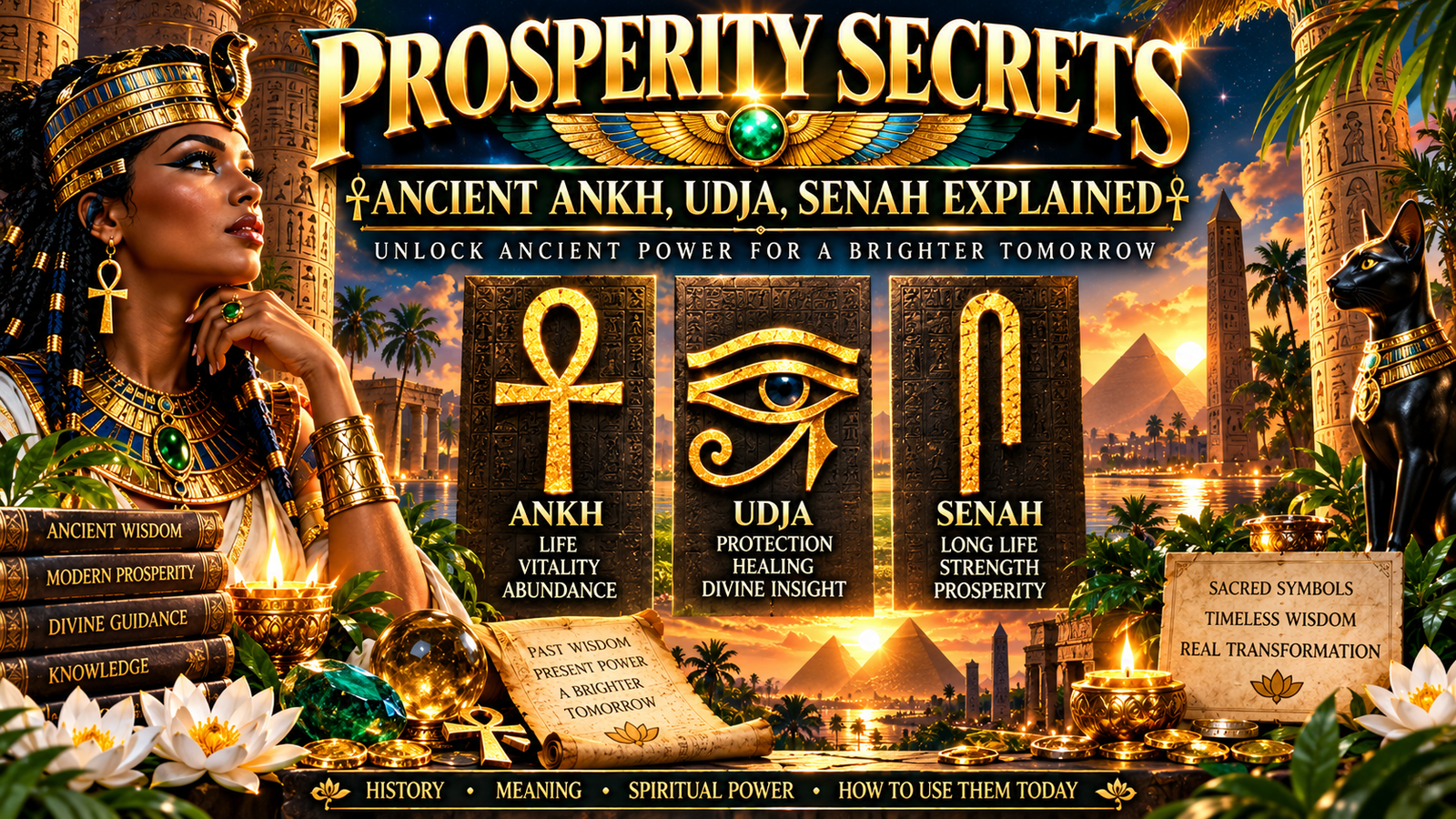
For thousands of years, the sacred symbols of ancient Egypt have fascinated people with their beauty, mystery, and spiritual significance. Carved into temple walls, painted inside tombs, fashioned into jewelry, and carried as amulets, these symbols were far more than decoration. They communicated powerful ideas about life, protection, health, divine authority, renewal, and well-being.
Among the symbols associated today with prosperity and a flourishing life are the Ankh, the Udja—more commonly transliterated as Wedjat or Udjat—and Senah/Seneb.
But were these really ancient Egyptian “money symbols”?
Not exactly.
Their original meanings were broader and, in many ways, more powerful. Rather than promising riches alone, they represented qualities the ancient Egyptians considered essential to a successful existence: life, wholeness, protection, health, stability, and divine blessing.
Understanding their historical meanings gives us a much richer way to appreciate them today.
The Ankh: The Sacred Symbol of Life
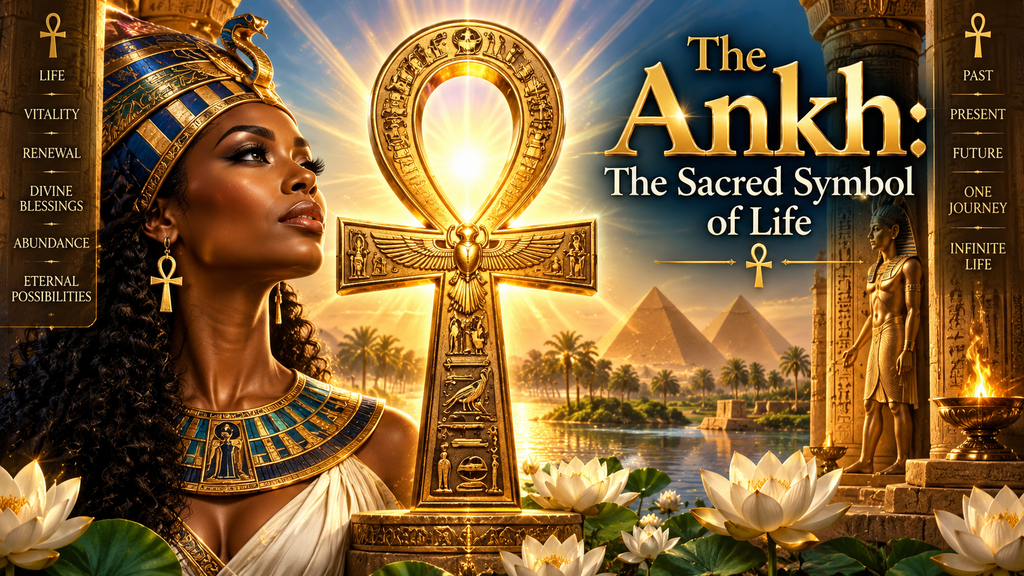
The Ankh is probably the most recognizable symbol associated with ancient Egypt.
Its Egyptian meaning is remarkably clear. The Ankh hieroglyph was used for words meaning “live,” “alive,” and “life,” and eventually became a symbol of life itself.
Ancient Egyptian artwork frequently depicts deities holding an Ankh or presenting it to a pharaoh. In some scenes, the symbol is positioned near the nose, connecting divine life with breath and vitality.
The Ankh therefore wasn’t simply a symbol of material prosperity. It represented something even more fundamental:
Life. Vitality. Continuation. Divine life.
Its association with life also extended beyond physical existence into ideas surrounding continued existence after death.
The Ankh and Prosperity
From a modern spiritual perspective, it is easy to understand why the Ankh has become connected with abundance.
True prosperity requires more than money. It can encompass health, vitality, longevity, opportunity, spiritual fulfillment, security, and the ability to enjoy what we have.
The Ankh can therefore serve today as a reminder to pursue a life that is abundant on every level.
Affirmation:
“I welcome abundant life, vitality, opportunity, and divine blessings into my experience.”
The Udja: The Restored Eye of Horus
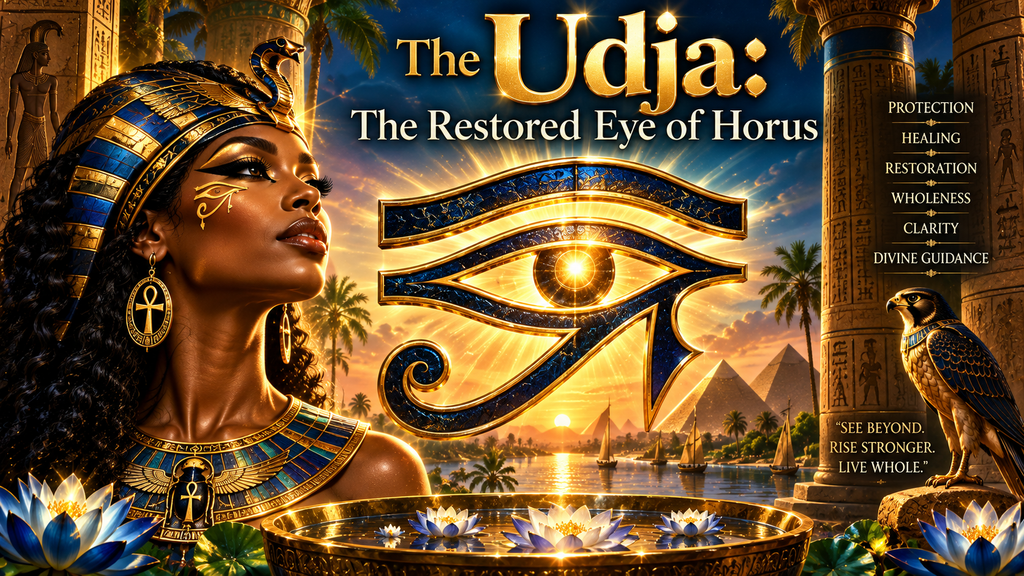
The symbol sometimes called Udja, Udjat, Wedjat, or the Eye of Horus carries a very different meaning.
Its ancient Egyptian name is commonly transliterated wedjat, meaning something like “the sound one” or “the restored/whole one.”
According to Egyptian mythology, the eye of Horus was injured or lost during his conflict with Seth and was subsequently restored. Because of this story, the Wedjat became strongly associated with healing, restoration, protection, regeneration, and becoming whole again.
It became one of ancient Egypt’s most popular protective amulets. Examples were used by the living and also placed with the dead.
That historical meaning gives us an intriguing prosperity connection.
Prosperity isn’t only about gaining something new.
Sometimes prosperity begins by restoring what has been depleted.
Restoring your health.
Rebuilding your confidence.
Recovering from financial difficulties.
Protecting what you have already created.
Recognizing opportunities more clearly.
The Wedjat can therefore be interpreted in contemporary spiritual practice as a reminder of protection, recovery, wholeness, and renewal—while remembering that claims about attracting money specifically are modern interpretations rather than established ancient Egyptian meanings.
Affirmation:
“I am protected, restored, whole, and open to opportunities that support my well-being.”
Senah or Seneb: Health, Well-Being and the Prosperous Life
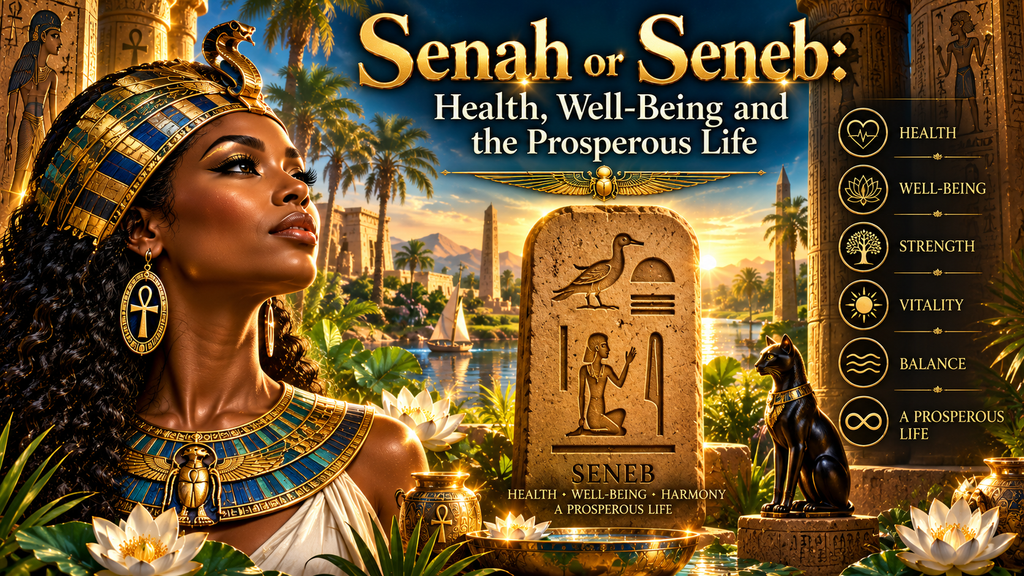
This third concept needs a little clarification because modern spiritual graphics sometimes use varying spellings.
The ancient Egyptian word commonly transliterated seneb (snb) is associated with health and well-being. This matters because ancient Egyptian ideas of flourishing were not restricted to possessions.
One of the best-known Egyptian expressions combines three powerful concepts:
Ankh — Life
Wedja — Prosperity or well-being
Seneb — Health
The expression is often rendered in English as:
“Life, prosperity, and health.”
This tells us something important about ancient Egyptian ideas of a good life.
Prosperity existed alongside life and health.
What good is wealth without the vitality to enjoy it?
What good is success without well-being?
What good are possessions if your life is unstable?
The ancient combination presents something much closer to whole-life prosperity than simply accumulating money.
Ancient Egyptian Prosperity Was Bigger Than Money
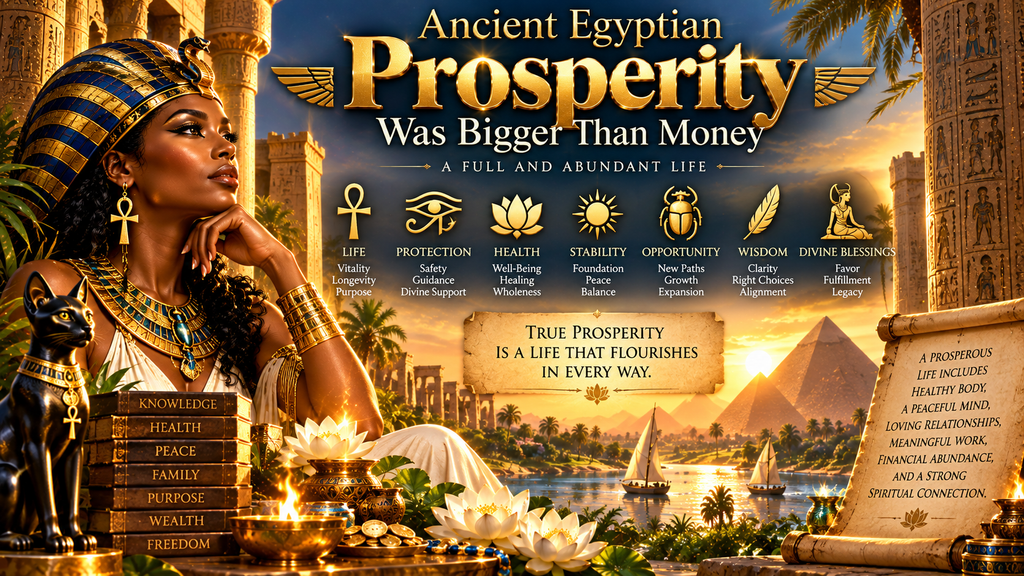
This is perhaps the most valuable lesson hidden inside these symbols.
Today, when we hear the word prosperity, our first thought may be money.
Ancient Egyptian symbolism presents a much wider vocabulary.
Life mattered.
Health mattered.
Protection mattered.
Stability mattered.
Regeneration mattered.
Divine order mattered.
Power and authority mattered.
The Metropolitan Museum of Art, for example, preserves an ancient combination of the Ankh (life), Djed (stability), and Was (dominion/power). These symbols could appear together as a powerful combination of wishes.
Prosperity, viewed through this broader lens, becomes the condition of having the foundations necessary for life to flourish.
How to Work With These Symbols Today
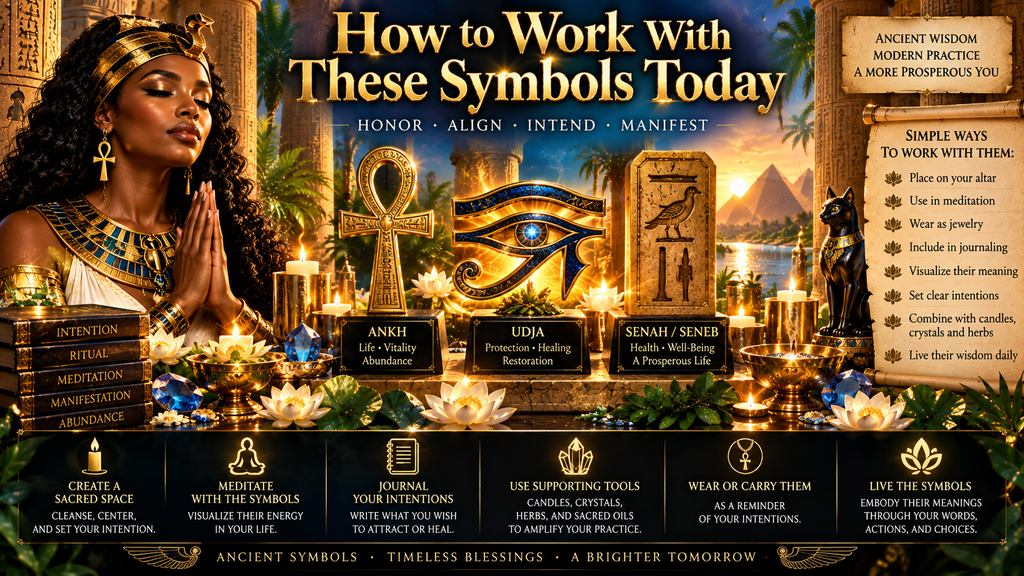
You don’t have to pretend that ancient Egyptians practiced the modern Law of Attraction to find contemporary spiritual meaning in their symbols.
Instead, you can honor their historical meanings while allowing them to inspire your own intentions.
The Ankh can represent your intention for abundant life and vitality.
The Wedjat/Udjat can represent protection, healing, restoration, and wholeness.
Seneb can remind you to include health and well-being in your definition of prosperity.
You might place representations of these symbols on an altar or meditation space, use them in journaling, study their history, wear historically inspired jewelry, or contemplate their meanings during meditation.
The important distinction is that these are modern personal spiritual applications inspired by ancient symbols, not necessarily rituals documented from ancient Egypt.
A Simple Prosperity Meditation Inspired by Ancient Egyptian Symbolism
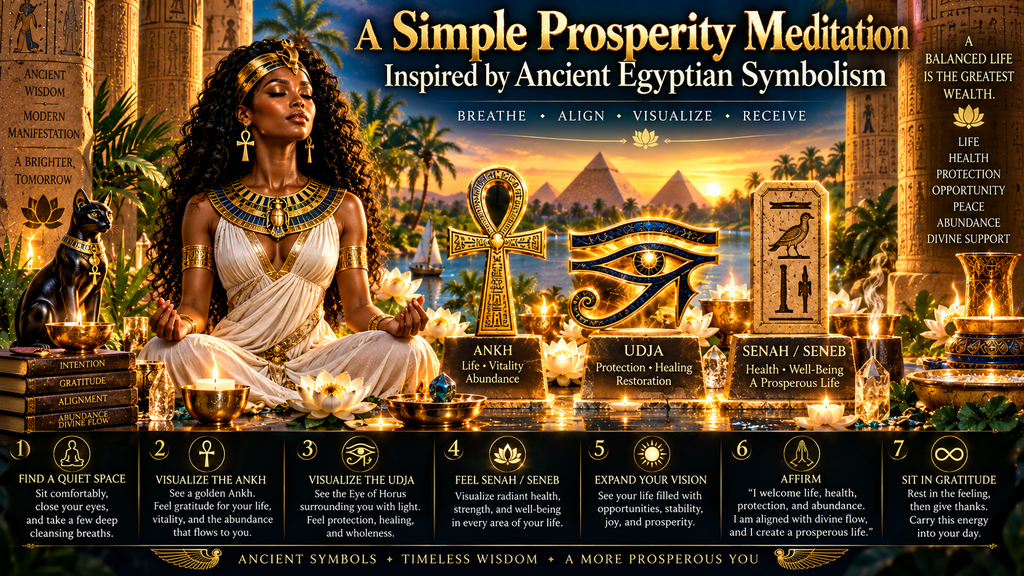
Sit somewhere quiet and take several slow breaths.
Visualize a golden Ankh before you.
Think:
Life.
Feel gratitude for your existence, your vitality, and everything you still have the opportunity to experience.
Next, visualize the Wedjat Eye.
Think:
Wholeness. Protection. Restoration.
Consider an area of your life that needs to become whole again.
Finally, contemplate health and well-being—Seneb.
Think about what prosperity would look like if it included your body, mind, home, relationships, purpose, security, and financial resources.
Then affirm:
“I welcome life, health, protection, stability, restoration, opportunity, and abundance. I create prosperity by honoring the whole of my life.”
Take another breath and allow yourself to sit quietly with that intention.
The Deeper Prosperity Secret
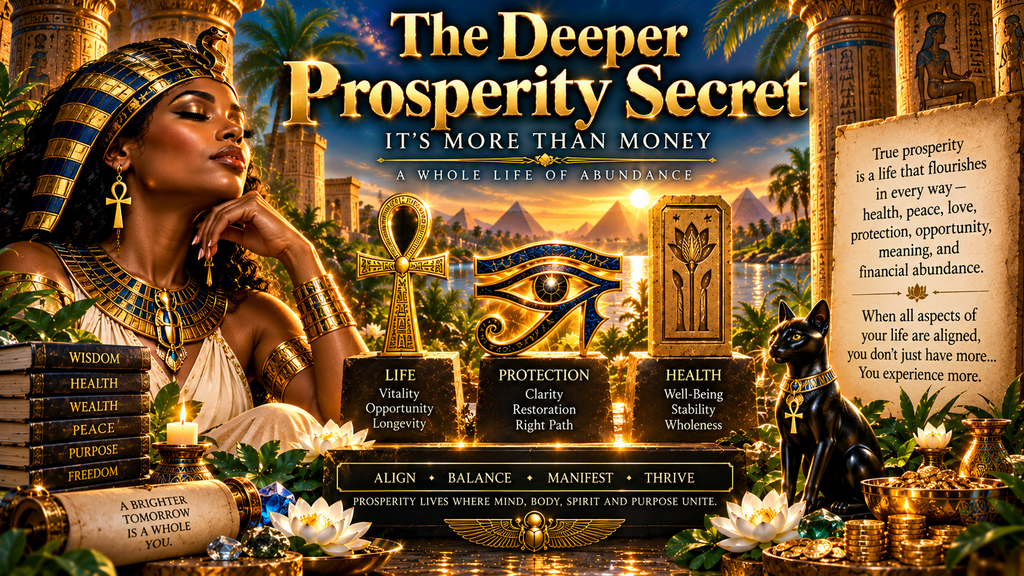
Perhaps the greatest secret contained within these ancient ideas is surprisingly simple:
Prosperity is not one thing.
Money can be part of prosperity, but prosperity can also mean having the health to enjoy your success, the stability to preserve it, the wisdom to use it, the protection to safeguard it, and the vitality to continue creating.
The Ankh reminds us to live.
The Wedjat reminds us that what has been damaged can become whole again.
Seneb reminds us that health and well-being are themselves forms of wealth.
Together, they offer a powerful modern reflection on abundance:
Don’t manifest only more. Build a life capable of flourishing.
Prosperity Affirmations:
I am surrounded by life, abundance, protection, and opportunity.
My life is continually expanding into greater prosperity and well-being.
I protect, appreciate, and wisely grow the abundance already present in my life.
I am restored, supported, healthy, prosperous, and whole
.I welcome wealth in every form—health, peace, opportunity, wisdom, love, and financial abundance.