A Great Wagon by Rumi: Beyond Right and Wrong Into Spiritual Unity
Rumi’s A Great Wagon invites us to move beyond the divisions that so often shape human experience—right and wrong, judgment and blame, separation and belonging—and enter a deeper state of spiritual awareness. Its most famous passage begins, “Out beyond ideas of wrongdoing and rightdoing…” and points toward a symbolic meeting place beyond ordinary labels and conflict. The “field” Rumi describes can be understood not necessarily as a physical place, but as a state of consciousness where the ego’s need to judge, defend, compare, and separate begins to dissolve.
At the heart of the poem are themes of transcendence, unity, divine love, and awakening. Rumi encourages us to consider what becomes possible when we stop viewing ourselves and others entirely through opposing categories. Beyond those divisions lies an experience of connection—a recognition that beneath our differences, we participate in something greater than ourselves.
From a spiritual perspective, the poem can also be read as an invitation to awakening. The field represents the inner stillness we encounter when mental noise quiets and we become more receptive to presence, compassion, love, and the Divine. Rumi is not necessarily asking us to abandon discernment or pretend that actions have no consequences. Instead, his imagery points toward a level of consciousness deeper than the arguments and judgments that normally dominate our minds.
This is one reason A Great Wagon continues to resonate centuries after Rumi’s lifetime. Its message speaks to anyone who has felt exhausted by conflict, division, regret, or the constant pressure to decide who is right and who is wrong. Rumi offers another possibility: step beyond the argument for a moment, enter the field of awareness, and discover what remains when separation falls away.
Perhaps that is where true awakening begins—not by winning every argument, but by discovering the place within us where love, presence, and unity are greater than the divisions we have created.
Finding Lasting Happiness Through Joy, Gratitude, and Inner Transformation
What if true wealth isn’t measured by the size of your bank account, but by the peace in your heart?
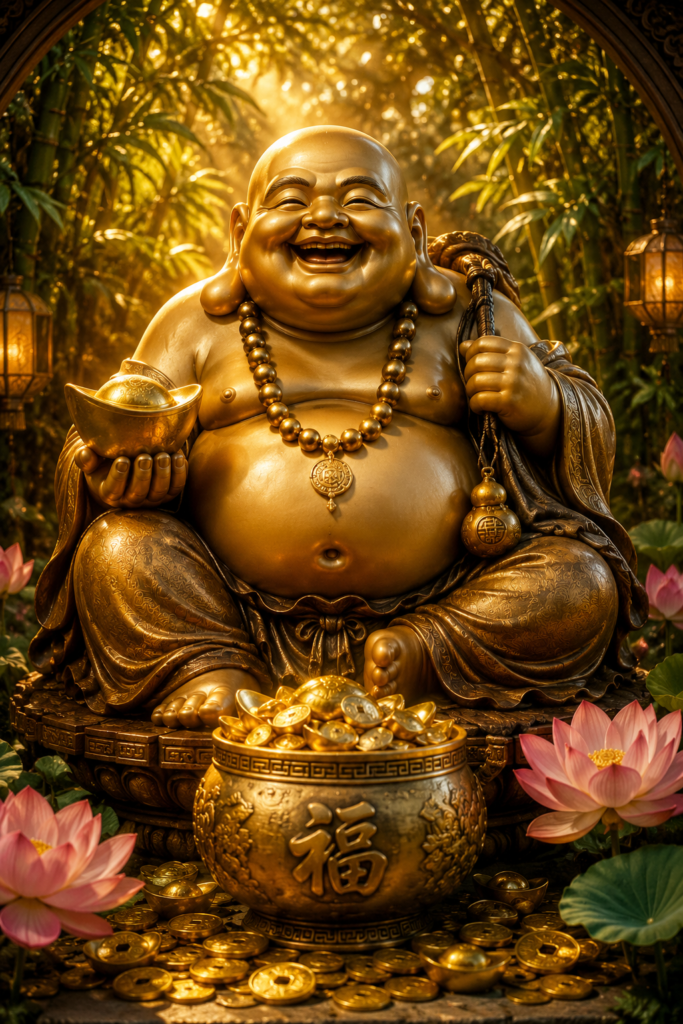
For centuries, the image of the Laughing Buddha has inspired millions around the world. His joyful smile, carefree spirit, and generous heart remind us that happiness is not something we chase—it is something we cultivate.
In Laughing Buddha: The Alchemy of Euphoric Living, Sakshi Chetana explores the transformative power of joy, mindfulness, and conscious living. The book encourages readers to shift their perspective from fear and scarcity toward gratitude, compassion, and inner abundance.
Whether you’re beginning a spiritual journey or deepening an existing practice, its message is timeless: true prosperity begins within.
Who Is the Laughing Buddha?
The Laughing Buddha is commonly associated with Budai, a wandering monk who lived in China during the 10th century.
Known for his infectious laughter, generous nature, and cloth sack filled with gifts, Budai became a beloved symbol of:
Joy
Generosity
Contentment
Prosperity
Compassion
Good Fortune
Optimism
It’s important to note that Budai is not the historical Gautama Buddha. Instead, he represents a folk tradition that celebrates happiness, kindness, and abundance.
What Does “Alchemy of Euphoric Living” Mean?
Alchemy traditionally referred to transforming ordinary metals into gold.
Spiritually, alchemy represents transforming the inner self.
The “alchemy of euphoric living” is about turning:
Fear into confidence
Scarcity into gratitude
Stress into peace
Negativity into compassion
Limitation into possibility
Rather than changing the outside world first, this philosophy begins with transforming your mindset, attitudes, and daily habits.
Five Principles of Euphoric Living
1. Choose Gratitude Every Day
Gratitude helps shift attention from what is missing to what is already present.
Consider ending each day by writing down three things you appreciate, no matter how small.
2. Laugh More Often
Laughter reduces stress, strengthens relationships, and reminds us not to carry every burden alone.
The Laughing Buddha symbolizes finding light even during difficult seasons.
3. Give Generously
Generosity is about more than money.
You can give:
Time
Encouragement
Kindness
Knowledge
Compassion
A listening ear
Acts of generosity often enrich both the giver and the receiver.
4. Release What You Cannot Control
Holding onto worry rarely changes outcomes.
Instead, focus your energy on actions you can take today while accepting that some circumstances remain beyond your control.
5. Find Joy in Ordinary Moments
Euphoric living doesn’t require extraordinary events.
Joy can be found in:
A sunrise
A meaningful conversation
Quiet meditation
Time with loved ones
Helping another person
Appreciating nature
Learning to notice these moments can make everyday life feel richer.
A Daily Joy Practice
Try this five-minute routine:
Take three slow, mindful breaths.
Smile intentionally.
Repeat an uplifting affirmation.
Reflect on one recent blessing.
Choose one act of kindness for the day.
Simple habits, practiced consistently, can shape how you experience life.
The enduring appeal of the Laughing Buddha lies in his reminder that happiness is an inner practice rather than a destination.
Books like Laughing Buddha: The Alchemy of Euphoric Living invite readers to cultivate gratitude, generosity, mindfulness, and resilience. While these practices cannot guarantee specific outcomes, they can help build a healthier mindset and a deeper appreciation for life’s everyday blessings.
When you nurture joy from within, you often become better equipped to face challenges, recognize opportunities, and share encouragement with others.
Key Takeaways
The Laughing Buddha symbolizes joy, generosity, and contentment.
Spiritual “alchemy” refers to inner transformation rather than material change.
Gratitude, kindness, and mindfulness are practical ways to cultivate a more joyful life.
Lasting abundance includes peace, purpose, relationships, and personal growth—not only financial success.
“Coincidences are God’s way of remaining anonymous.” While this quote is often attributed to others rather than Carl Jung himself, it captures a feeling many people experience: moments in life that seem too meaningful to be mere chance.
Have you ever looked at the clock and seen 11:11 repeatedly? Thought about someone moments before they called? Met a stranger who completely changed the direction of your life? Or noticed the same symbol, animal, or message appearing again and again?
Many people dismiss these moments as coincidence. But Swiss psychiatrist Carl Jung proposed a fascinating possibility: perhaps some coincidences carry meaning.
He called this phenomenon synchronicity.
For nearly a century, Jung’s theory has influenced psychology, spirituality, philosophy, dream analysis, and modern manifestation teachings. Today, countless people use the idea of synchronicity as a way to reflect on life’s unexpected connections and deepen their understanding of themselves.
Let’s explore what synchronicity really means—and why so many people believe nothing in life is entirely random.
Who Was Carl Jung?
Carl Jung (1875–1961) was one of the most influential psychologists in modern history.
Originally a colleague of Sigmund Freud, Jung eventually developed his own school of thought known as Analytical Psychology.
His work introduced concepts that remain influential today, including:
The Collective Unconscious
Archetypes
The Shadow
Individuation
Dream Symbolism
Psychological Types
Synchronicity
Unlike many psychologists of his era, Jung believed that symbols, myths, dreams, and spiritual experiences could provide valuable insight into human development.
What Is Synchronicity?
Jung defined synchronicity as:
A meaningful coincidence between an inner psychological state and an external event that lacks a direct causal relationship.
In simple terms:
Two events occur that are not connected by cause and effect, yet they feel deeply related in meaning.
For example:
You think about an old friend, and they contact you unexpectedly.
You repeatedly encounter the same number sequence during a major life transition.
You begin researching a topic, and books, conversations, and opportunities related to it seem to appear everywhere.
A chance meeting leads to a career, friendship, or relationship that changes your life.
According to Jung, these experiences invite reflection rather than immediate conclusions.
Synchronicity Is Different From Chance
Random coincidence happens all the time.
Synchronicity, according to Jung, is different because it carries personal significance.
The event resonates emotionally.
It feels as though something important is trying to capture your attention.
Whether interpreted psychologically, spiritually, or symbolically, synchronicities often inspire people to pause and ask:
What does this mean to me?
Why am I noticing this now?
What is happening in my life?
The meaning comes from the individual’s experience, not from a universal rule.
The Collective Unconscious
To understand synchronicity, it’s helpful to know another of Jung’s most influential ideas:
The Collective Unconscious.
Jung proposed that beneath our personal unconscious lies a deeper layer of the psyche shared by all humanity.
Within this collective unconscious exist universal patterns called archetypes.
These include timeless figures and themes such as:
The Wise Old Sage
The Hero
The Mother
The Shadow
The Child
The Trickster
Across cultures and throughout history, these archetypes appear in myths, dreams, religions, and stories.
Jung believed synchronicities often arise when these deeper psychological patterns become active in our lives.
Common Examples of Synchronicity
Many people describe experiences such as:
Repeating Numbers
Seeing sequences like:
111
222
333
444
777
1111
While Jung did not specifically teach “angel numbers,” many modern spiritual traditions interpret repeated number patterns as invitations to reflect on one’s current circumstances.
Meaningful Encounters
Meeting exactly the right person at exactly the right moment.
A conversation changes everything.
Symbolic Animals
Butterflies.
Owls.
Ravens.
Dragonflies.
Many people assign symbolic meaning to recurring animals, though interpretations vary widely by culture and tradition.
Dreams
Dreams sometimes seem to mirror events that later occur or highlight issues we later encounter in waking life. Jung saw dreams as a rich source of symbolic insight.
Books That Find You
Have you ever noticed that the “right” book seems to appear just when you need it?
Many people experience this as a meaningful coincidence.
Can Synchronicity Support Manifestation?
Many modern manifestation teachers connect synchronicity with the process of pursuing meaningful goals.
As people clarify their intentions and become more attentive, they may notice opportunities, patterns, and connections that previously went overlooked.
Psychology also offers an explanation: when we focus on something important, our attention naturally becomes more sensitive to related information. This selective attention can make meaningful connections feel more visible.
Whether viewed psychologically, spiritually, or both, synchronicity can encourage openness, curiosity, and intentional action.
How to Become More Aware of Synchronicities
You don’t need to force synchronicity.
Instead, cultivate awareness.
Keep a Journal
Write down unusual coincidences, dreams, repeating symbols, or unexpected encounters.
Over time, patterns may emerge.
Practice Mindfulness
Slowing down can make it easier to notice experiences that might otherwise be overlooked.
Reflect Before Reacting
Rather than assuming every coincidence has a hidden message, ask thoughtful questions about what the experience means to you.
Explore Your Dreams
Dream journaling was one of Jung’s favorite tools for self-discovery.
Stay Curious
Approach unusual experiences with openness rather than certainty.
Curiosity leaves room for both wonder and critical thinking.
Synchronicity and Spirituality
Although Jung approached synchronicity through psychology, many spiritual traditions have embraced the concept.
People may interpret meaningful coincidences as:
Moments of divine timing
Spiritual encouragement
Intuitive guidance
Symbolic reminders
Invitations to personal growth
These interpretations vary according to individual beliefs and traditions.
A Balanced Perspective
Synchronicity can be a meaningful framework for reflecting on life, but it’s also important not to assume that every event carries hidden significance.
Human beings are naturally skilled at recognizing patterns, and sometimes coincidences are simply coincidences.
Jung himself encouraged careful reflection rather than unquestioning acceptance.
The value of synchronicity lies less in proving supernatural causes and more in the insight these experiences may inspire.
Carl Jung’s theory of synchronicity continues to inspire psychologists, spiritual seekers, writers, and curious minds around the world.
Whether you interpret meaningful coincidences through the lens of psychology, spirituality, or personal reflection, they can encourage you to slow down, pay attention, and consider how your inner life connects with the world around you.
Perhaps the greatest gift of synchronicity is not providing definitive answers, but inviting us to ask deeper questions about purpose, meaning, and the unfolding journey of our lives.
The next time life surprises you with an unexpected connection, pause for a moment. Rather than asking, “Was this random?” you might instead ask, “What can I learn from this experience?”
That simple shift in perspective may open the door to greater self-awareness and a richer appreciation of life’s mysteries.
Key Takeaways
Carl Jung introduced the concept of synchronicity to describe meaningful coincidences that are not linked by direct cause and effect.
Synchronicity emphasizes personal meaning, not prediction or certainty.
Jung connected synchronicity with the collective unconscious and universal archetypes.
Many people use synchronicity as a tool for self-reflection, mindfulness, and personal growth.
Staying curious and grounded helps balance wonder with critical thinking.
Frequently Asked Questions
Did Carl Jung believe in angel numbers?
No. Jung did not teach the modern concept of angel numbers. However, his work on symbols, archetypes, and synchronicity has influenced many contemporary spiritual interpretations of repeating numbers.
Is synchronicity scientifically proven?
Synchronicity is a psychological and philosophical concept rather than a scientifically established law. While psychology recognizes pattern recognition and selective attention, Jung’s broader interpretation remains a topic of discussion and personal belief.
Can everyone experience synchronicity?
Many people report meaningful coincidences throughout their lives. Whether these experiences are viewed as psychological, spiritual, or simply memorable coincidences depends on individual perspective.
Have you ever noticed how people say they’ve “woken up” spiritually? It’s a phrase that appears everywhere in conversations about personal growth, mindfulness, and consciousness. But is there a difference between being awake and simply waking up? While these words are often used interchangeably, they can describe different stages of a person’s journey toward greater awareness. Understanding that distinction can help you recognize where you are today and inspire you to keep growing. What Does It Mean to Wake Up? Waking up is the beginning. Just as we awaken from sleep each morning, a spiritual awakening often begins with a moment—or a series of moments—that causes us to see life differently. For some, this comes after a major life event:
The loss of a loved one
A serious illness
The end of a relationship
A career change
A personal crisis
An unexpected experience that changes their perspective Others awaken gradually through meditation, prayer, study, time in nature, or quiet reflection. The common thread is a growing realization that there may be more to life than routines, habits, and external success. Questions begin to arise:
Why am I here?
What is my purpose?
What truly brings lasting peace?
Am I living authentically?
What beliefs have I accepted without examining them? These questions often mark the first step toward greater awareness. What Does It Mean to Be Awake? If waking up is the doorway, being awake is the ongoing journey. Rather than a single event, many people view being awake as a continuing practice of living with greater awareness, compassion, and intention. Someone who considers themselves spiritually awake may strive to:
Notice thoughts without becoming controlled by them.
Respond thoughtfully instead of reacting impulsively.
Practice gratitude regularly.
Develop emotional resilience.
Seek wisdom instead of constant distraction.
Live according to their values.
Continue learning and growing. Being awake does not mean being perfect. It means remaining open to learning, self-reflection, and positive change. Signs You May Be Experiencing a Spiritual Awakening Everyone’s path is unique, but many people describe experiences such as:
Feeling drawn toward meditation or prayer.
Becoming more aware of recurring habits and thought patterns.
Wanting deeper meaning in life.
Feeling more connected to nature.
Developing greater empathy for others.
Letting go of relationships or habits that no longer support personal growth.
Becoming curious about different spiritual traditions or philosophies.
Feeling a stronger desire to live authentically. These experiences vary from person to person and can have many different explanations. They do not necessarily indicate a specific spiritual event, but they often accompany periods of personal reflection and growth. Awareness Is a Daily Practice Many people assume awakening is a destination. In reality, growth often happens one decision at a time. Each day offers opportunities to become more aware through simple practices like:
Spending a few minutes in quiet meditation.
Keeping a gratitude journal.
Reflecting on your emotions instead of avoiding them.
Practicing forgiveness.
Spending time outdoors.
Limiting distractions that leave you feeling overwhelmed.
Reading books that encourage thoughtful reflection.
Serving others with kindness and compassion. Small daily choices can gradually shape the way we experience ourselves and the world around us. Common Misconceptions About Spiritual Awakening There are many myths surrounding awakening. Myth 1: Awake People Never Struggle Personal growth does not eliminate life’s challenges. Difficult emotions and setbacks are part of being human. Myth 2: Awakening Happens Overnight While some people describe dramatic moments of insight, lasting transformation usually develops over time through consistent practice and reflection. Myth 3: There Is Only One Path People explore spirituality in many different ways. Meditation, prayer, contemplative traditions, service to others, time in nature, philosophy, and creative expression can all become meaningful parts of someone’s journey. Practices That Can Support Your Journey If you want to deepen your awareness, consider exploring practices such as:
Mindfulness meditation
Breathwork
Journaling
Prayer
Yoga
Acts of kindness and service
Time in nature
Creative expression through art, music, or writing
Reflecting on meaningful spiritual or philosophical teachings The most important practice is the one you can return to consistently. Daily Affirmations
I welcome greater awareness into my life.
I grow wiser with every experience.
I trust my inner guidance.
I choose peace over fear.
I remain open to learning and transformation.
I honor my journey one step at a time.
I live with intention, gratitude, and compassion. Your Journey Is Uniquely Yours No one can tell you exactly what awakening should look like. For some, it begins with a quiet realization. For others, it follows profound life changes. However it starts, the journey is deeply personal. Rather than striving to become someone else, awakening often invites us to become more fully ourselves—living with honesty, curiosity, and purpose. Whether you describe yourself as waking up or already awake, every moment offers another opportunity to learn, grow, and choose a path aligned with your values. Growth is not about reaching perfection. It is about continuing to move toward greater awareness, compassion, and wisdom. Continue Your Journey with Awake and Conquer If you’re exploring spirituality, mindfulness, manifestation, energy work, angelic teachings, or metaphysical traditions, you’re in the right place. At Awake and Conquer, we share practical guidance, thoughtful reflections, and spiritual tools designed to inspire personal growth while encouraging discernment and intentional living. Every day is another opportunity to awaken to your highest potential.
What is Spirituality? Spirituality is a deeply personal and transformative journey—one that transcends religious structures and rigid doctrines. It is the pursuit of a connection with something greater than oneself, whether that be the universe, divine consciousness, or the higher self. Unlike organized religion, spirituality is fluid and individualized, allowing each person to explore their own beliefs, practices, and experiences. At its core, it is about seeking meaning, inner peace, and a profound understanding of existence.
The Importance of Spirituality In today’s fast-paced and often chaotic world, spirituality serves as an anchor—a refuge from stress, uncertainty, and external pressures. It offers a path to inner harmony, emotional resilience, and a deeper awareness of life’s interconnectedness. Spiritual practices such as meditation, mindfulness, breathwork, and energy healing can cultivate a heightened sense of presence, intuition, and inner strength.
Beyond personal growth, spirituality also nurtures compassion, gratitude, and a sense of unity with all living beings. It opens the heart to divine wisdom, fosters self-discovery, and empowers individuals to live authentically, guided by their highest truth.
Ways to Cultivate Spirituality There is no single path to spiritual awakening—each journey is unique. Here are some powerful ways to deepen your spiritual connection:
Meditation & Mindfulness – Quiet the mind, expand awareness, and tune into the present moment. Sacred Rituals & Prayer – Engage in spiritual practices that align with your beliefs, such as chanting, affirmations, or lighting candles. Energy Healing & Reiki – Balance and cleanse your energetic field to promote spiritual and emotional well-being. Journaling & Self-Reflection – Explore your inner world by writing down thoughts, intentions, and experiences. Nature Connection – Spend time outdoors to absorb the healing energy of the Earth and align with its rhythms. Sacred Texts & Wisdom Teachings – Learn from ancient spiritual traditions, esoteric knowledge, and mystical philosophies. Manifestation & Visualization – Harness the power of intention and the law of attraction to create your highest reality.
True spirituality is about embracing the journey—being open to transformation, seeking higher wisdom, and living in alignment with your soul’s purpose. Whether through silent contemplation or cosmic exploration, the path is yours to walk, and the universe is waiting to guide you.