pinterest-site-verification=81e6ebea8354f222dd417de7656dad6e

Tag: #yorubaspirituality

  • Oshun Feast Day September 8: Honoring the Orisha of Love, Beauty, Prosperity & Abundance

    Every year on September 8, many devotees honor Oshun, one of the most beloved Orishas associated with fresh water, love, beauty, fertility, sensuality, joy, creativity, prosperity, and abundance.
    Golden, radiant, and intimately connected with rivers, Oshun represents far more than physical beauty. Her symbolism speaks to self-worth, sweetness, attraction, diplomacy, creativity, pleasure, generosity, and the ability to receive the goodness life has to offer.
    Her flowing waters also offer a powerful spiritual lesson: a river does not stop being a river when it encounters an obstacle. It finds another path.
    For anyone exploring African and African diasporic spiritual traditions, September 8 offers an opportunity to learn more about Oshun, appreciate the traditions surrounding her, and reflect on the qualities she represents.

    Who Is Oshun?

    Oshun is an Orisha originating within Yoruba religious tradition and honored in several African diasporic traditions.
    She is strongly associated with fresh water, particularly rivers.
    Oshun is commonly connected with:

    • Love and attraction
    • Beauty and sensuality
    • Fresh water and rivers
    • Fertility and motherhood
    • Prosperity and abundance
    • Joy and pleasure
    • Creativity and the arts
    • Diplomacy and sweetness
    • Self-worth and confidence
      Her imagery is frequently filled with brilliant yellow and gold, beautiful jewelry, mirrors, fans, flowers, flowing water, and honey.
      But reducing Oshun simply to beauty or romance misses much of her depth.
      Oshun also represents intelligence, determination, dignity, influence, and power.
      Her sweetness should never be mistaken for weakness.

    Why Is Oshun Honored on September 8?

    The September 8 observance is particularly associated with Afro-Cuban and Lukumí traditions, where Oshun became syncretically associated with Our Lady of Charity of El Cobre — La Virgen de la Caridad del Cobre, the Patroness of Cuba.
    The Catholic feast of Our Lady of Charity is celebrated on September 8.
    The relationship between Catholic saints and Orishas developed within a complicated history of colonialism, slavery, cultural survival, adaptation, and resistance.
    Enslaved Africans and their descendants preserved important elements of African spirituality despite tremendous pressure and restrictions on their religious practices.
    Over generations, associations developed between certain Catholic figures and particular Orishas.
    This is why September 8 became an important date for Oshun within some African diasporic communities.
    It is important, however, to understand that Oshun and Our Lady of Charity are not simply interchangeable figures. They originate in distinct religious traditions, even though historical syncretism created an important relationship between them.

    Oshun and the Spiritual Meaning of the River

    One of the most beautiful ways to understand Oshun is through her connection with flowing freshwater.
    A healthy river moves.
    It nourishes.
    It changes direction.
    It gives life.
    And when something blocks its path, water often finds another way forward.
    This makes the river a powerful symbol for examining our own lives.
    Where have you become stagnant?
    What are you desperately trying to force?
    What are you afraid to release?
    Where are you refusing to receive?
    And what might happen if you allowed yourself to move differently?
    Oshun’s association with flowing water can remind us that sometimes transformation doesn’t require pushing harder.
    Sometimes we need to change direction and begin flowing again.

    Oshun, Self-Worth and Magnetism

    Another powerful lesson associated with Oshun is recognizing your value.
    True magnetism isn’t simply about physical appearance.
    It begins internally.
    When you know your worth, you become more selective about what you accept.
    You stop begging for situations that continually reject you.
    You become more conscious of how you speak to yourself.
    You begin choosing relationships that offer respect rather than simply attention.
    You create boundaries around your time and energy.
    And you become more comfortable receiving.
    This creates a beautiful Feast Day reflection:
    Where am I accepting less than what I know I deserve?
    Write down whatever comes to mind.
    Then ask:
    What would I choose differently if I truly recognized my value?
    That answer may reveal something important.

    Oshun and the Sweetness of Life

    Honey is one of the substances famously associated with Oshun.
    Symbolically, honey represents sweetness.
    But sweetness is more profound than simply experiencing pleasure.
    Many people become so focused on responsibilities, survival, problems, and future goals that they forget to experience the life happening around them.
    There must also be room for:
    Beauty.
    Music.
    Rest.
    Laughter.
    Friendship.
    Love.
    Creativity.
    Pleasure.
    Celebration.
    Gratitude.
    The sweetness of life reminds us that abundance isn’t only measured by money.
    A prosperous life can also contain meaningful relationships, peaceful mornings, good health, opportunities, creativity, security, freedom, beautiful surroundings, and moments of genuine joy.

    Oshun and Prosperity

    Oshun is also widely associated with prosperity and abundance.
    This makes her symbolism especially meaningful for people seeking to develop a healthier relationship with receiving.
    Sometimes we unconsciously associate receiving with selfishness.
    We may feel comfortable giving but uncomfortable accepting help, compliments, opportunities, money, affection, or recognition.
    Yet healthy exchange requires both.
    Giving.
    And receiving.
    On September 8, consider asking yourself:
    Am I genuinely open to receiving what I say I desire?
    Then consider the opportunities already surrounding you.
    Abundance does not always arrive in the form we expect.
    Sometimes it arrives as an introduction.
    An idea.
    A new skill.
    A conversation.
    An unexpected opportunity.
    A closed door that redirects you toward something better.
    Or the courage to finally take action.

    A Simple and Respectful Oshun Feast Day Reflection

    If you are not initiated into a Yoruba or African diasporic religious tradition, you can keep your observance simple and respectful rather than attempting ceremonies that traditionally require specific religious knowledge or initiation.
    Create a peaceful space for reflection.
    You may choose beautiful yellow or gold flowers and place a bowl of clean fresh water nearby as a symbolic reminder of Oshun’s connection with rivers.
    Sit quietly.
    Take several slow breaths.
    Look into the water and think about what you are ready to stop carrying.
    Ask yourself:
    What needs to begin flowing again in my life?
    Then consider love, finances, creativity, relationships, confidence, career, spirituality, and your relationship with yourself.
    Choose one area where you are ready for movement.
    Write:
    “I allow positive movement to begin here.”
    Keep the paper somewhere meaningful as a reminder of your intention.

    A Mirror Practice for Self-Worth

    Because mirrors are commonly associated with Oshun’s imagery, you can also use the day for a simple self-worth reflection.

    Stand comfortably in front of a mirror.

    Look directly into your own eyes.

    Instead of examining your appearance, concentrate on the person looking back at you.

    Then slowly say:

    “I recognize my worth.”

    “I honor the person I am becoming.”

    “I receive love that respects and values me.”

    “I allow prosperity to enter my life.”

    “I am worthy of joy, beauty, dignity and abundance.”

    Repeat the affirmations slowly rather than rushing through them.

    Allow yourself to actually hear what you’re saying.

    5 Powerful Oshun-Inspired Affirmations

    Use these affirmations on September 8 or whenever you want to reconnect with the qualities of confidence, flow, beauty and abundance:
    1. I am radiant, worthy, confident and magnetic.
    2. Love that honors and respects me flows naturally into my life.
    3. Prosperity and beautiful opportunities flow freely toward me.
    4. I welcome joy, creativity, pleasure and abundance into my life.
    5. Like the river, I continually flow toward everything aligned with my highest good.

    A Prayer of Honor for Oshun

    Radiant Oshun,
    Lady of the flowing waters,
    I honor the beauty, wisdom, sweetness, love and abundance you represent.
    May the rivers of my life continue to flow.
    May stagnant pathways begin moving.
    May I recognize my worth without depending upon the approval of others.
    May healthy love surround me.
    May prosperity find fertile ground in my life.
    May creativity awaken within me.
    May joy return to places where heaviness has remained too long.
    Give me wisdom to recognize when I should stand firmly and when I should flow around the obstacle.
    May my heart remain open while my discernment remains strong.
    May I remember that I am worthy of dignity, respect, beauty, joy, love and abundance.
    And may I remain grateful for the sweetness already present within my life. May the river continue to flow.

    Honoring Oshun Through Your Everyday Life

    Perhaps one of the most meaningful ways to reflect on Oshun isn’t limited to September 8.
    Carry the lesson forward.
    Bring flowers into your home.
    Take care of your body.
    Protect freshwater and the natural environment.
    Create something beautiful.
    Dance.
    Listen to music.
    Practice gratitude.
    Treat yourself with dignity.
    Stop chasing relationships that don’t honor you.
    Allow yourself to receive compliments.
    Celebrate other people’s successes without believing they diminish your own.
    Make your surroundings more beautiful.
    Create financial goals that support the life you want.
    And remember to enjoy some of what you work so hard to create.
    Spirituality shouldn’t only teach us how to endure life.
    It can also remind us how to experience it.

    The Lesson of Oshun: Let Your Life Flow

    Oshun’s river carries a timeless message.
    You do not have to force every door.
    You do not have to chase everything.
    You do not have to diminish yourself to receive love.
    And you do not have to prove your worth before allowing yourself to experience joy.
    Sometimes the next chapter begins when you stop fighting the current.
    Release what has become stagnant.
    Recognize your worth.
    Welcome sweetness.
    Remain open to opportunity.
    And allow yourself to receive.
    This September 8, may love fill your heart, joy fill your home, prosperity fill your path, and abundance flow through your life like a beautiful, never-ending river.

    Happy Feast Day to Oshun.

    Continue Your Spiritual Journey

    If you enjoyed this celebration of Oshun, explore more spiritual wisdom, sacred traditions, manifestation practices, affirmations, Orisha teachings, angelic guidance, and abundance practices with Awake and Conquer.
    Subscribe to the Awake and Conquer YouTube channel and continue your journey toward greater spiritual awareness, empowerment, prosperity, and intentional living.

  • Yemayá Feast Day: Honoring the Powerful Mother of Waters on September 7

    Every year on September 7, many devotees within the Afro-Cuban Lukumí tradition honor Yemayá, the magnificent Mother of Waters. Known as Yemọja in Yoruba tradition, she is one of the most beloved and widely recognized Òrìṣhà throughout the African diaspora.

    Her presence evokes the vastness of water itself—nurturing yet powerful, peaceful yet unstoppable.

    For those who honor Yemayá, her celebration is a beautiful opportunity to reflect upon motherhood, protection, family, emotional healing, renewal, resilience, and the sacred waters that sustain all life.

    It is important to recognize that September 7 is particularly associated with Yemayá in Afro-Cuban/Lukumí practice through her historical association with Our Lady of Regla. Yemọja/Yemayá is honored differently across Yoruba and African diasporic traditions, and there is no single universal feast date observed by every lineage.

    Who Is Yemayá?

    Yemayá is the diasporic name commonly associated with Yemọja, an important Òrìṣhà whose origins are found among the Yoruba people of West Africa.

    In Yorubaland, Yemọja has historically been associated with fresh water and particularly the Ògùn River, while traditions that developed throughout the African diaspora—especially in Cuba and Brazil—expanded her powerful association with the sea and ocean.

    This distinction is important.

    Today, many people immediately picture Yemayá standing before an enormous blue ocean. That imagery is deeply rooted in diasporic traditions, but her history reaches back to the rivers of Yorubaland.

    Her name is commonly interpreted in connection with the Yoruba expression “Mother whose children are fish.”

    It is a magnificent spiritual image: an immense mother whose children are as numerous as the fish within the waters.

    Yemayá: Mother of Waters

    Water is essential to life.

    Before we ever take our first breath, we develop surrounded by water within the womb.

    Water nourishes us.

    Water cleanses us.

    Water sustains the Earth.

    And water continuously moves.

    These qualities help us understand why Yemayá has become such a profound symbol of motherhood, fertility, nurturing, protection, family and emotional depth.

    But there is another side to water that should never be forgotten.

    The ocean can be gentle enough to touch your feet with a quiet wave—and powerful enough to reshape an entire coastline.

    Yemayá therefore offers a beautiful spiritual lesson:

    Being nurturing does not mean being weak.

    You can love deeply while maintaining boundaries.

    You can care for others without abandoning yourself.

    You can be compassionate while protecting your peace.

    And you can be gentle while possessing extraordinary strength.

    Why Is Yemayá Honored on September 7?

    Within Afro-Cuban Lukumí tradition, September 7 became strongly associated with Yemayá through her syncretic relationship with Our Lady of Regla, whose Catholic feast is celebrated on that date.

    This connection developed under complex historical circumstances as enslaved Africans and their descendants preserved African religious traditions in colonial societies dominated by Christianity.

    African spiritual traditions survived despite tremendous pressure, persecution and cultural disruption.

    As a result, Catholic saints and Marian figures became historically associated with various Òrìṣhà within some diasporic traditions.

    That does not mean Yemayá and Our Lady of Regla originated as the same spiritual figure.

    Rather, their association reflects part of the complicated history through which African religious traditions survived and evolved throughout the diaspora.

    The Spiritual Meaning of Yemayá

    For many devotees, Yemayá carries powerful associations with:

    Motherhood • Protection • Family • Fertility • Nurturing • Water • Emotional strength • Healing • Renewal • Resilience

    Her symbolism can also encourage us to examine our emotional lives.

    Water flows rather than remaining permanently trapped in one place.

    Sometimes we need to do the same.

    We may hold onto disappointment.

    Old relationships.

    Grief.

    Fear.

    Anger.

    Regret.

    Or even an outdated version of ourselves.

    Yemayá’s waters can become a powerful metaphor for asking:

    What am I ready to stop carrying?

    And perhaps an even more important question:

    What becomes possible when I finally release it?

    A Respectful Way to Reflect on Yemayá’s Feast Day

    If you belong to a Yoruba, Lukumí or other African diasporic religious tradition, honor Yemayá according to the practices taught within your lineage.

    If you are simply learning about Yemayá, you do not need to imitate ceremonies, offerings or initiatory practices you have not been taught.

    You can instead use September 7 as an opportunity for respectful reflection and education.

    Spend some quiet time near water.

    Learn about Yoruba history and spirituality.

    Support the preservation of oceans, rivers and waterways.

    Express gratitude toward the mothers and maternal figures who have nurtured you.

    Offer kindness to someone who needs emotional support.

    And remember to nurture yourself as well.

    A Simple Water Reflection

    For a personal spiritual reflection—not as a substitute for a traditional Yemayá ceremony—place a bowl or glass of clean water before you.

    Sit quietly and take three slow breaths.

    Think about something emotionally heavy that you are ready to release.

    You might silently say:

    “I release what no longer belongs in my life. I allow peace, healing and emotional renewal to flow through me.”

    Then think about what you want to welcome into your life.

    Peace.

    Healthy relationships.

    Protection.

    Healing.

    Confidence.

    Prosperity.

    Love.

    Clarity.

    Imagine yourself moving toward those qualities as naturally as water moves toward its destination.

    Yemayá-Inspired Affirmations

    “I am protected, nurtured and surrounded by loving energy.”

    “I move through life’s changes with the strength and wisdom of flowing water.”

    “I release emotional burdens and welcome peace into my heart.”

    “I protect my energy while remaining open to healthy love, abundance and meaningful relationships.”

    “I am emotionally renewed, spiritually grounded and confidently moving toward my highest good.”

    These are modern affirmations inspired by the themes explored in this article; they are not presented as traditional Yoruba or Lukumí prayers.

    Honoring the Mothers

    Yemayá’s feast day also provides an opportunity to recognize something universal—the extraordinary power of motherhood.

    We honor biological mothers.

    Grandmothers.

    Ancestors.

    Women who raised children who were not biologically theirs.

    Women who became protectors, teachers and caregivers.

    And all those whose nurturing presence helped another person survive, grow or believe in themselves.

    There is enormous power in nurturing life.

    And there is equally enormous power in learning when to nurture yourself.

    A Tribute to Yemayá

    On this September 7, we honor the generations who have preserved the traditions surrounding Yemayá.

    We honor the waters.

    We honor motherhood.

    We honor protection.

    We honor resilience.

    We honor emotional healing.

    And we honor the ability to begin again.

    Because water teaches us something extraordinary:

    It does not need to fight every obstacle it encounters.

    Sometimes it moves around it.

    Sometimes it moves beneath it.

    Sometimes it slowly transforms it.

    But eventually…

    water finds a way forward.

    May that be your reminder today.

    Yemayá Feast Day Affirmation

    “I flow forward with wisdom and grace. I am nurtured, protected, emotionally renewed, and open to the blessings unfolding in my life.”

    Àṣẹ.

    Continue Your Journey With Awake and Conquer

    If you enjoyed this tribute to Yemayá, Mother of Waters, explore more of our content about Òrìṣà wisdom, Yoruba spirituality, African spiritual traditions, ancestors, manifestation, affirmations, and sacred practices here at Awake and Conquer.

    And remember:

    Honor the waters. Honor the mothers. Honor the wisdom that continues to flow.

  • Ori: The Sacred Power of Your Destiny in Yoruba Spirituality

    What if one of the most important spiritual forces influencing your destiny isn’t somewhere outside of you?
    What if it is intimately connected to who you are, the choices you make, the character you develop, and the path you came here to walk?
    In Yoruba spiritual philosophy, this profound concept is known as Ori.
    The Yoruba word orí literally means “head.” Yet within Yoruba religious and philosophical thought, Ori can have a much deeper meaning. It is associated with the inner or spiritual head, individual destiny, personal consciousness, and the unique direction of one’s life.
    Understanding Ori introduces us to a powerful idea:
    Destiny may give us a path, but character influences how we walk it.
    What Is Ori?
    At its simplest level, Ori means the physical head.
    However, Yoruba thought also distinguishes the physical or outer head from the deeper spiritual dimension commonly discussed as Ori Inu, the inner head.
    Ori Inu is intimately associated with the individual person and their destiny.
    This makes Ori different from simply thinking about a guardian spirit standing outside of you. It is profoundly personal—connected with your own existence and the life that is yours to live.
    Within Yoruba philosophy, the head carries enormous symbolic and spiritual significance because it represents far more than physical appearance. It is associated with consciousness, individuality, direction, and destiny.
    Ori and Your Destiny
    One of the most fascinating teachings surrounding Ori concerns destiny.
    Traditional Yoruba thought includes the understanding that human beings come into earthly existence with an individual destiny.
    One term associated with destiny is ayanmo, referring to that which has been apportioned or assigned to an individual.
    This does not necessarily mean that human beings are powerless actors following an unchangeable script.
    Quite the opposite.
    Yoruba philosophy places tremendous importance on how a person actually lives.
    Your decisions matter.
    Your behavior matters.
    Your relationships matter.
    Your wisdom matters.
    And above all, your character matters.
    This creates an important relationship between destiny and personal responsibility.
    You may have a particular path to walk, but you are still responsible for the manner in which you walk it.
    Ori Is Not Simply Another Orisha
    This distinction is important.
    Yoruba religion recognizes numerous Òrìṣà, divine powers associated with different forces and dimensions of existence.
    Ori, however, has an extraordinarily personal relationship with the individual.
    Your Ori is your Ori.
    This does not mean Ori replaces the Òrìṣà, nor does it mean that Ori should be confused with Olódùmarè, the Supreme Being within Yoruba religious thought.
    Rather, these concepts occupy different places within a sophisticated spiritual cosmology.
    Reducing Ori to something like a modern “manifestation tool” misses much of its religious and philosophical depth.
    Ori asks us to consider something much greater:
    What is the life that is truly mine to live?
    Ori and Iwa: Why Character Matters
    You cannot fully explore the philosophy surrounding destiny without encountering another important Yoruba concept:
    Iwa—character.
    A related expression is iwa pele, often translated along the lines of gentle, good, or balanced character.
    This includes qualities such as:

    • Patience
    • Integrity
    • Respect
    • Wisdom
    • Self-control
    • Responsibility
    • Consideration for others
      This teaching carries an important spiritual message.
      It isn’t enough simply to ask:
      “What is destined for me?”
      We should also ask:
      “What kind of person am I becoming?”
      Imagine being presented with extraordinary opportunities but lacking the discipline to maintain them.
      Imagine receiving abundance but lacking the wisdom to manage it.
      Imagine attracting relationships while repeatedly treating people poorly.
      Destiny cannot become an excuse for avoiding personal responsibility.
      Character determines how we respond when opportunities, challenges, relationships, losses, successes, and unexpected changes appear along our path.
      This is one reason the philosophy of Ori remains so relevant today.
      Ori and Ifá
      Ori is also connected with the broader spiritual world of Ifá.
      Ifá is a sophisticated Yoruba divination and knowledge tradition associated with Orunmila, the Òrìṣà of wisdom and divination.
      Through traditional Ifá divination, properly trained practitioners may seek insight concerning an individual’s circumstances, challenges, choices, spiritual obligations, character, and destiny.
      Traditionally trained practitioners include Babalawos and, within traditions that recognize them, Iyanifas.
      This distinction matters because Ifá is not simply a method of randomly selecting messages or predicting the future.
      It is a living religious and philosophical tradition involving extensive knowledge, training, lineage, and, where appropriate, initiation.
      Anyone interested in traditional ceremonies, divination, offerings, or initiatory practices should therefore seek guidance from a knowledgeable and reputable practitioner rather than relying solely upon material found online.
      What Ori Can Teach Us About Comparison
      There is another beautiful lesson we can draw from the philosophy of Ori.
      Someone else’s path does not have to become yours.
      Modern life constantly encourages comparison.
      We see someone’s career.
      Their house.
      Their relationship.
      Their financial success.
      Their appearance.
      Their spiritual journey.
      And increasingly, we see carefully edited versions of people’s lives on social media.
      Without realizing it, we can begin chasing someone else’s definition of success.
      The philosophy of Ori gives us another question to consider:
      What if your greatest success comes from becoming more aligned with your own path rather than copying someone else’s?
      Someone else’s opportunity may not be yours.
      Someone else’s timing may not be yours.
      Someone else’s spiritual journey may not be yours.
      And someone else’s definition of abundance may not be yours.
      Your responsibility is to walk your path with wisdom.
      A Simple Daily Reflection for Honoring Your Path
      You do not need to imitate ceremonies from a tradition in which you have not been trained to appreciate the wisdom contained within its philosophy.
      Instead, begin with reflection.
      Before reaching for your phone in the morning, spend a few quiet minutes with yourself.
      Breathe slowly.
      Become still.
      If it feels appropriate, gently place your hands upon your head and reflect on three questions:
      Am I living according to my deepest values?
      Are my daily choices strengthening or weakening the life I want to create?
      Am I following my own path—or trying to live someone else’s?
      Don’t force an answer.
      Listen.
      Then choose one action you can take that day that reflects greater wisdom, integrity, patience, courage, or responsibility.
      This turns spirituality into something practical.
      Because spiritual alignment isn’t only something we seek during rituals.
      It is something we practice through the way we live.
      An Ori-Inspired Affirmation
      Use this affirmation as a personal reflection rather than presenting it as a traditional Yoruba prayer:
      “I walk my path with wisdom, integrity, and good character. I honor the destiny that is mine to fulfill.”
      Repeat it slowly.
      Then ask yourself:
      What would living that affirmation actually look like today?
      That question transforms words into action.
      The Deeper Lesson of Ori
      Perhaps one of the greatest lessons we can take from Ori is that destiny is not merely something we wait to receive.
      It invites responsibility.
      It invites self-knowledge.
      It invites character.
      And it invites us to stop abandoning our own path simply because someone else’s journey appears more impressive.
      Instead of continually asking:
      “When will my destiny finally arrive?”
      Try asking:
      “What kind of person must I become to walk my destiny well?”
      That question can change everything.
      Honor your path.
      Develop your character.
      Make wiser choices.
      And remember that the life meant for you should not require you to become a copy of someone else.
      Walk your path with intention.
      Honor your Ori.
      And become the person capable of carrying your destiny well.
      Continue Your Journey with Awake and Conquer
      If you enjoy exploring ancient spiritual wisdom, metaphysical philosophy, manifestation, sacred traditions, personal transformation, and the deeper mysteries of consciousness, continue your journey with Awake and Conquer.
      And remember:
      Your spiritual journey isn’t only about discovering what awaits you. It is also about discovering who you are becoming along the way.
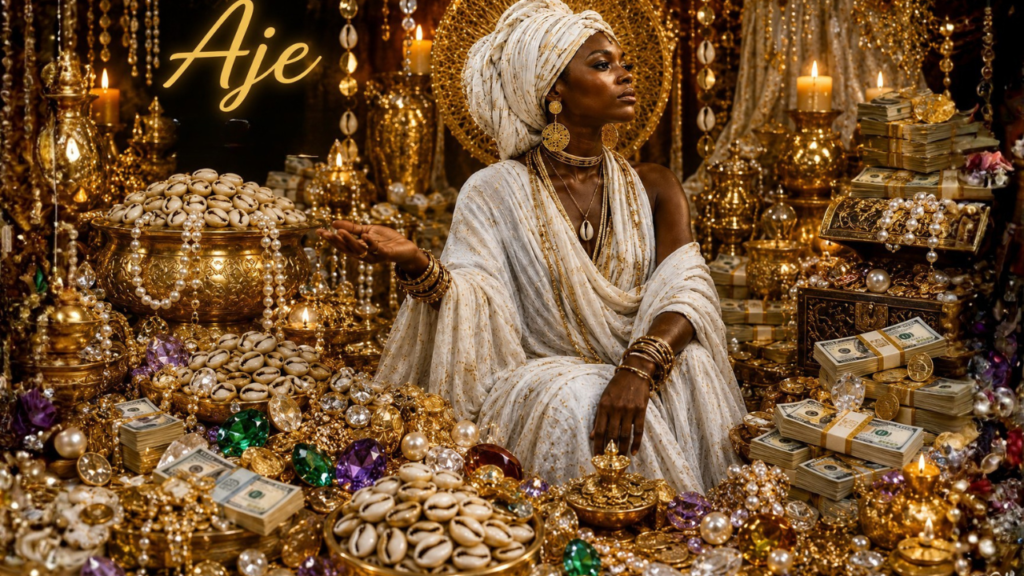
  • Orisha Aje: Discover the Ancient African Spirit of Wealth, Prosperity & Abundance

    Discover the Sacred Spirit of Prosperity

    What if wealth was more than numbers in a bank account? What if prosperity was a sacred energy—one that embraces health, opportunity, generosity, peace, and purpose?

    In the rich spiritual traditions of the Yoruba people of West Africa, one revered divine force embodies this expansive understanding of abundance: Orisha Aje. Honored as the spirit of wealth, commerce, and prosperity, Aje reminds us that true riches are built through gratitude, integrity, wise action, and blessings that uplift both ourselves and our communities.

    Whether you’re exploring African spirituality, seeking inspiration for a prosperity practice, or simply curious about ancient wisdom, the teachings surrounding Aje offer timeless insights into living an abundant life.


    Who Is Orisha Aje?

    In many Yoruba traditions, Aje is honored as an Orisha associated with wealth, prosperity, commerce, and abundance. In other traditions, Aje is understood as the sacred spiritual force or divine embodiment of prosperity itself.

    Unlike some Orisha whose stories and family lineages are widely established, Aje is understood differently among various Yoruba traditions, including Ifá, Isese, Lukumí, and Candomblé. This diversity reflects the living nature of these traditions and their rich oral heritage.

    Regardless of the interpretation, Aje represents the divine flow of blessings that allows individuals, families, businesses, and entire communities to flourish.


    Prosperity Means More Than Money

    One of the most beautiful teachings connected with Aje is that prosperity extends far beyond financial wealth.

    True abundance includes:

    • Good health
    • Loving relationships
    • A peaceful home
    • Meaningful work
    • Wisdom
    • Opportunity
    • Food and nourishment
    • Generosity
    • Spiritual fulfillment
    • Lasting happiness

    Money is considered one expression of prosperity—but not the only one.


    Wealth as Sacred Energy

    In Yoruba philosophy, wealth is not something to be worshipped.

    Instead, it is viewed as a sacred resource that should be earned honestly, managed wisely, and shared generously.

    Prosperity becomes a blessing when it allows us to:

    • Support our families
    • Help those in need
    • Build thriving communities
    • Create opportunities
    • Leave a positive legacy

    This perspective encourages a balanced relationship with abundance rather than the endless pursuit of material possessions.


    Aje and Commerce

    Aje has long been associated with:

    • Merchants
    • Entrepreneurs
    • Artists
    • Farmers
    • Craftspeople
    • Traders
    • Business owners
    • Investors

    Traditional marketplaces were often viewed as sacred spaces where prosperity flowed throughout the community. Every honest exchange represented another expression of Aje’s blessings.


    Monday: The Day of Prosperity

    Within Yoruba tradition, Monday (Ojó Ajé) is closely associated with commerce and prosperity.

    Many people choose Monday to:

    • Pray for financial blessings
    • Begin new business ventures
    • Review financial goals
    • Express gratitude
    • Set intentions for the week ahead

    Beginning the week with gratitude and purpose symbolizes opening the door to new opportunities.


    Symbols Associated with Aje

    Many sacred symbols are connected with prosperity and abundance.

    Cowrie Shells

    Perhaps the best-known symbol of Aje.

    Cowrie shells were once used as currency throughout parts of Africa and remain powerful symbols of prosperity, blessings, and wealth.


    Gold

    Gold represents:

    • Divine favor
    • Enduring prosperity
    • Success
    • Value
    • Royalty

    Honey

    Honey symbolizes:

    • Sweetness
    • Attraction
    • Favor
    • Joy
    • Harmonious relationships

    Just as honey sweetens food, many practitioners view it as a reminder to cultivate kindness and gratitude in daily life.


    Coins

    Coins represent:

    • Circulation
    • Opportunity
    • Growth
    • Financial flow

    Rather than remaining stagnant, prosperity is meant to continue moving and benefiting others.


    Calabashes

    Traditional calabashes are often associated with:

    • Receiving blessings
    • Spiritual abundance
    • Provision
    • Gratitude

    Many prosperity altars include beautifully decorated calabashes filled with symbolic items.


    Creating an Aje-Inspired Prosperity Altar

    You don’t need an elaborate shrine to honor the principles of abundance.

    A simple prosperity altar might include:

    • A gold or yellow cloth
    • A bowl of cowrie shells
    • A few coins
    • A small dish of honey
    • A green or gold candle
    • Fresh flowers
    • A gratitude or prosperity journal

    The purpose is not the objects themselves, but the mindset they help cultivate: gratitude, focus, generosity, and purposeful action.


    A Simple Prosperity Prayer

    Divine Aje,

    May honest prosperity flow into my life.

    Bless my work.

    Bless my home.

    Bless every opportunity before me.

    May I receive abundance with gratitude,

    use it wisely,

    and share my blessings generously.

    May my prosperity become a blessing to others.

    Aṣẹ.


    The Power of Aṣẹ

    No discussion of Yoruba spirituality is complete without mentioning Aṣẹ (pronounced ah-SHAY).

    Aṣẹ is the divine life force that empowers creation, purpose, speech, blessings, and action.

    Many practitioners conclude prayers by saying “Aṣẹ,” affirming that the prayer is empowered and brought into alignment with divine will.


    Living an Abundant Life

    The teachings surrounding Aje encourage us to:

    • Work diligently
    • Practice generosity
    • Remain grateful
    • Act with integrity
    • Continue learning
    • Invest wisely
    • Help others prosper

    When prosperity benefits an entire community, it becomes lasting wealth rather than temporary fortune.


    Daily Prosperity Practice

    Consider beginning each day with these simple habits:

    ✔ Express gratitude for three blessings.

    ✔ Review one financial goal.

    ✔ Learn one new skill.

    ✔ Take one action that moves you toward your dreams.

    ✔ Celebrate every victory, no matter how small.

    Small, consistent actions often create extraordinary long-term results.


    Prosperity Affirmations

    Repeat these affirmations daily:

    ✨ I welcome prosperity into every area of my life.

    ✨ Wealth flows to me with integrity and purpose.

    ✨ I attract opportunities that support my highest good.

    ✨ My work creates lasting abundance.

    ✨ I use my blessings wisely and generously.

    ✨ Every day my prosperity expands.

    ✨ I am grateful for the abundance already present in my life.


    Final Thoughts

    Whether you view Aje as an Orisha, a sacred spiritual force, or a timeless symbol of abundance, the message remains deeply relevant today.

    Prosperity begins with gratitude.

    It grows through wisdom.

    It expands through honest work.

    And it flourishes when shared with others.

    May the timeless teachings associated with Aje inspire you to cultivate a life filled with purpose, generosity, and lasting abundance.

    Aṣẹ.


    Continue Your Journey

    If you enjoyed learning about Aje, you may also enjoy exploring:

    • Olodumare: The Supreme Creator in Yoruba Spirituality
    • Olokun: Keeper of the Deep Ocean and Hidden Treasures
    • Oshun: Orisha of Love, Beauty, and Sweet Waters
    • Yemayá: Mother of the Ocean and Divine Compassion
    • Oya: Orisha of Transformation and Powerful Change

    Stay connected with Awake and Conquer for more articles on African spirituality, Orishas, angels, sacred symbols, prosperity practices, and timeless wisdom for personal and spiritual growth.