Finding Lasting Happiness Through Joy, Gratitude, and Inner Transformation
What if true wealth isn’t measured by the size of your bank account, but by the peace in your heart?
For centuries, the image of the Laughing Buddha has inspired millions around the world. His joyful smile, carefree spirit, and generous heart remind us that happiness is not something we chase—it is something we cultivate.
In Laughing Buddha: The Alchemy of Euphoric Living, Sakshi Chetana explores the transformative power of joy, mindfulness, and conscious living. The book encourages readers to shift their perspective from fear and scarcity toward gratitude, compassion, and inner abundance.
Whether you’re beginning a spiritual journey or deepening an existing practice, its message is timeless: true prosperity begins within.
Who Is the Laughing Buddha?
The Laughing Buddha is commonly associated with Budai, a wandering monk who lived in China during the 10th century.
Known for his infectious laughter, generous nature, and cloth sack filled with gifts, Budai became a beloved symbol of:
Joy
Generosity
Contentment
Prosperity
Compassion
Good Fortune
Optimism
It’s important to note that Budai is not the historical Gautama Buddha. Instead, he represents a folk tradition that celebrates happiness, kindness, and abundance.
What Does “Alchemy of Euphoric Living” Mean?
Alchemy traditionally referred to transforming ordinary metals into gold.
Spiritually, alchemy represents transforming the inner self.
The “alchemy of euphoric living” is about turning:
Fear into confidence
Scarcity into gratitude
Stress into peace
Negativity into compassion
Limitation into possibility
Rather than changing the outside world first, this philosophy begins with transforming your mindset, attitudes, and daily habits.
Five Principles of Euphoric Living
1. Choose Gratitude Every Day
Gratitude helps shift attention from what is missing to what is already present.
Consider ending each day by writing down three things you appreciate, no matter how small.
2. Laugh More Often
Laughter reduces stress, strengthens relationships, and reminds us not to carry every burden alone.
The Laughing Buddha symbolizes finding light even during difficult seasons.
3. Give Generously
Generosity is about more than money.
You can give:
Time
Encouragement
Kindness
Knowledge
Compassion
A listening ear
Acts of generosity often enrich both the giver and the receiver.
4. Release What You Cannot Control
Holding onto worry rarely changes outcomes.
Instead, focus your energy on actions you can take today while accepting that some circumstances remain beyond your control.
5. Find Joy in Ordinary Moments
Euphoric living doesn’t require extraordinary events.
Joy can be found in:
A sunrise
A meaningful conversation
Quiet meditation
Time with loved ones
Helping another person
Appreciating nature
Learning to notice these moments can make everyday life feel richer.
A Daily Joy Practice
Try this five-minute routine:
Take three slow, mindful breaths.
Smile intentionally.
Repeat an uplifting affirmation.
Reflect on one recent blessing.
Choose one act of kindness for the day.
Simple habits, practiced consistently, can shape how you experience life.
The enduring appeal of the Laughing Buddha lies in his reminder that happiness is an inner practice rather than a destination.
Books like Laughing Buddha: The Alchemy of Euphoric Living invite readers to cultivate gratitude, generosity, mindfulness, and resilience. While these practices cannot guarantee specific outcomes, they can help build a healthier mindset and a deeper appreciation for life’s everyday blessings.
When you nurture joy from within, you often become better equipped to face challenges, recognize opportunities, and share encouragement with others.
Key Takeaways
The Laughing Buddha symbolizes joy, generosity, and contentment.
Spiritual “alchemy” refers to inner transformation rather than material change.
Gratitude, kindness, and mindfulness are practical ways to cultivate a more joyful life.
Lasting abundance includes peace, purpose, relationships, and personal growth—not only financial success.
“Coincidences are God’s way of remaining anonymous.” While this quote is often attributed to others rather than Carl Jung himself, it captures a feeling many people experience: moments in life that seem too meaningful to be mere chance.
Have you ever looked at the clock and seen 11:11 repeatedly? Thought about someone moments before they called? Met a stranger who completely changed the direction of your life? Or noticed the same symbol, animal, or message appearing again and again?
Many people dismiss these moments as coincidence. But Swiss psychiatrist Carl Jung proposed a fascinating possibility: perhaps some coincidences carry meaning.
He called this phenomenon synchronicity.
For nearly a century, Jung’s theory has influenced psychology, spirituality, philosophy, dream analysis, and modern manifestation teachings. Today, countless people use the idea of synchronicity as a way to reflect on life’s unexpected connections and deepen their understanding of themselves.
Let’s explore what synchronicity really means—and why so many people believe nothing in life is entirely random.
Who Was Carl Jung?
Carl Jung (1875–1961) was one of the most influential psychologists in modern history.
Originally a colleague of Sigmund Freud, Jung eventually developed his own school of thought known as Analytical Psychology.
His work introduced concepts that remain influential today, including:
The Collective Unconscious
Archetypes
The Shadow
Individuation
Dream Symbolism
Psychological Types
Synchronicity
Unlike many psychologists of his era, Jung believed that symbols, myths, dreams, and spiritual experiences could provide valuable insight into human development.
What Is Synchronicity?
Jung defined synchronicity as:
A meaningful coincidence between an inner psychological state and an external event that lacks a direct causal relationship.
In simple terms:
Two events occur that are not connected by cause and effect, yet they feel deeply related in meaning.
For example:
You think about an old friend, and they contact you unexpectedly.
You repeatedly encounter the same number sequence during a major life transition.
You begin researching a topic, and books, conversations, and opportunities related to it seem to appear everywhere.
A chance meeting leads to a career, friendship, or relationship that changes your life.
According to Jung, these experiences invite reflection rather than immediate conclusions.
Synchronicity Is Different From Chance
Random coincidence happens all the time.
Synchronicity, according to Jung, is different because it carries personal significance.
The event resonates emotionally.
It feels as though something important is trying to capture your attention.
Whether interpreted psychologically, spiritually, or symbolically, synchronicities often inspire people to pause and ask:
What does this mean to me?
Why am I noticing this now?
What is happening in my life?
The meaning comes from the individual’s experience, not from a universal rule.
The Collective Unconscious
To understand synchronicity, it’s helpful to know another of Jung’s most influential ideas:
The Collective Unconscious.
Jung proposed that beneath our personal unconscious lies a deeper layer of the psyche shared by all humanity.
Within this collective unconscious exist universal patterns called archetypes.
These include timeless figures and themes such as:
The Wise Old Sage
The Hero
The Mother
The Shadow
The Child
The Trickster
Across cultures and throughout history, these archetypes appear in myths, dreams, religions, and stories.
Jung believed synchronicities often arise when these deeper psychological patterns become active in our lives.
Common Examples of Synchronicity
Many people describe experiences such as:
Repeating Numbers
Seeing sequences like:
111
222
333
444
777
1111
While Jung did not specifically teach “angel numbers,” many modern spiritual traditions interpret repeated number patterns as invitations to reflect on one’s current circumstances.
Meaningful Encounters
Meeting exactly the right person at exactly the right moment.
A conversation changes everything.
Symbolic Animals
Butterflies.
Owls.
Ravens.
Dragonflies.
Many people assign symbolic meaning to recurring animals, though interpretations vary widely by culture and tradition.
Dreams
Dreams sometimes seem to mirror events that later occur or highlight issues we later encounter in waking life. Jung saw dreams as a rich source of symbolic insight.
Books That Find You
Have you ever noticed that the “right” book seems to appear just when you need it?
Many people experience this as a meaningful coincidence.
Can Synchronicity Support Manifestation?
Many modern manifestation teachers connect synchronicity with the process of pursuing meaningful goals.
As people clarify their intentions and become more attentive, they may notice opportunities, patterns, and connections that previously went overlooked.
Psychology also offers an explanation: when we focus on something important, our attention naturally becomes more sensitive to related information. This selective attention can make meaningful connections feel more visible.
Whether viewed psychologically, spiritually, or both, synchronicity can encourage openness, curiosity, and intentional action.
How to Become More Aware of Synchronicities
You don’t need to force synchronicity.
Instead, cultivate awareness.
Keep a Journal
Write down unusual coincidences, dreams, repeating symbols, or unexpected encounters.
Over time, patterns may emerge.
Practice Mindfulness
Slowing down can make it easier to notice experiences that might otherwise be overlooked.
Reflect Before Reacting
Rather than assuming every coincidence has a hidden message, ask thoughtful questions about what the experience means to you.
Explore Your Dreams
Dream journaling was one of Jung’s favorite tools for self-discovery.
Stay Curious
Approach unusual experiences with openness rather than certainty.
Curiosity leaves room for both wonder and critical thinking.
Synchronicity and Spirituality
Although Jung approached synchronicity through psychology, many spiritual traditions have embraced the concept.
People may interpret meaningful coincidences as:
Moments of divine timing
Spiritual encouragement
Intuitive guidance
Symbolic reminders
Invitations to personal growth
These interpretations vary according to individual beliefs and traditions.
A Balanced Perspective
Synchronicity can be a meaningful framework for reflecting on life, but it’s also important not to assume that every event carries hidden significance.
Human beings are naturally skilled at recognizing patterns, and sometimes coincidences are simply coincidences.
Jung himself encouraged careful reflection rather than unquestioning acceptance.
The value of synchronicity lies less in proving supernatural causes and more in the insight these experiences may inspire.
Carl Jung’s theory of synchronicity continues to inspire psychologists, spiritual seekers, writers, and curious minds around the world.
Whether you interpret meaningful coincidences through the lens of psychology, spirituality, or personal reflection, they can encourage you to slow down, pay attention, and consider how your inner life connects with the world around you.
Perhaps the greatest gift of synchronicity is not providing definitive answers, but inviting us to ask deeper questions about purpose, meaning, and the unfolding journey of our lives.
The next time life surprises you with an unexpected connection, pause for a moment. Rather than asking, “Was this random?” you might instead ask, “What can I learn from this experience?”
That simple shift in perspective may open the door to greater self-awareness and a richer appreciation of life’s mysteries.
Key Takeaways
Carl Jung introduced the concept of synchronicity to describe meaningful coincidences that are not linked by direct cause and effect.
Synchronicity emphasizes personal meaning, not prediction or certainty.
Jung connected synchronicity with the collective unconscious and universal archetypes.
Many people use synchronicity as a tool for self-reflection, mindfulness, and personal growth.
Staying curious and grounded helps balance wonder with critical thinking.
Frequently Asked Questions
Did Carl Jung believe in angel numbers?
No. Jung did not teach the modern concept of angel numbers. However, his work on symbols, archetypes, and synchronicity has influenced many contemporary spiritual interpretations of repeating numbers.
Is synchronicity scientifically proven?
Synchronicity is a psychological and philosophical concept rather than a scientifically established law. While psychology recognizes pattern recognition and selective attention, Jung’s broader interpretation remains a topic of discussion and personal belief.
Can everyone experience synchronicity?
Many people report meaningful coincidences throughout their lives. Whether these experiences are viewed as psychological, spiritual, or simply memorable coincidences depends on individual perspective.
Have you ever wondered why some people seem to attract abundance effortlessly while others feel like they’re constantly pushing against invisible barriers? You work hard, practice affirmations, visualize your goals, and stay positive—yet financial breakthroughs, meaningful relationships, or career opportunities still seem just out of reach.
According to Christie Marie Sheldon, the answer may lie beneath the surface. She teaches that many people unknowingly carry energetic patterns and subconscious beliefs that quietly influence their ability to receive abundance.
Her work encourages people to look beyond external circumstances and explore the inner patterns that may be affecting their lives. Whether you are new to manifestation or have been studying metaphysics for years, understanding these hidden abundance blocks can become a powerful step toward personal growth.
Who Is Christie Marie Sheldon?
Christie Marie Sheldon is an energy healer, author, and teacher best known for her work on abundance consciousness and energetic transformation. She has worked with thousands of individuals around the world, helping them identify subconscious patterns they believe may influence finances, relationships, health, career success, and overall well-being.
Rather than focusing only on positive thinking, Sheldon emphasizes that deeply rooted beliefs and emotional experiences can shape how people perceive opportunities and respond to them.
Her teachings encourage developing greater self-awareness, emotional healing, and intentional action alongside a positive mindset.
What Are Hidden Abundance Blocks?
Abundance blocks are recurring mental, emotional, or behavioral patterns that may interfere with achieving personal goals.
These blocks often develop gradually through life experiences, family beliefs, culture, education, or stressful events.
Examples may include:
Fear of success
Fear of failure
Feeling undeserving
Scarcity thinking
Negative self-talk
Perfectionism
Difficulty receiving help
Financial guilt
Fear of judgment
Limiting beliefs about money
While different teachers explain these ideas in different ways, the common theme is that increasing awareness of these patterns may help people make more intentional choices.
The 24 Hidden Abundance Blocks
Christie Marie Sheldon describes twenty-four common patterns that can influence how people relate to success, prosperity, and opportunity. Although the wording may vary across her teachings, they generally include areas such as:
1. Feeling Unworthy
Believing you don’t deserve happiness, wealth, or success.
2. Fear of Success
Concern that success may create unwanted responsibilities, criticism, or change.
3. Fear of Failure
Avoiding opportunities because of the possibility of disappointment.
4. Scarcity Mindset
Believing there is never enough money, opportunity, love, or time.
5. Limiting Family Beliefs
Adopting financial beliefs passed down through generations without questioning them.
6. Negative Self-Image
Allowing self-doubt to limit personal growth.
7. Difficulty Receiving
Feeling uncomfortable accepting compliments, gifts, assistance, or opportunities.
8. Emotional Attachment to Struggle
Believing success must always require hardship.
9. Fear of Being Seen
Avoiding visibility despite having valuable gifts to share.
10. Fear of Criticism
Allowing other people’s opinions to determine your choices.
11. Lack of Self-Trust
Second-guessing your own decisions.
12. Perfectionism
Waiting for everything to be perfect before taking action.
13. Resentment
Holding onto unresolved anger that affects emotional well-being.
14. Guilt Around Money
Feeling guilty about earning or having financial success.
15. Comparison
Measuring your progress against others instead of your own growth.
16. Victim Mentality
Believing outside circumstances completely control your future.
17. Fear of Change
Resisting new opportunities because they require stepping outside your comfort zone.
18. Overworking
Believing worth is determined only through constant effort.
19. Lack of Boundaries
Giving so much to others that little energy remains for yourself.
20. Impatience
Expecting immediate results and becoming discouraged too quickly.
21. Self-Sabotage
Creating habits that unintentionally interfere with long-term goals.
22. Living in the Past
Allowing previous disappointments to define future possibilities.
23. Resistance to Receiving Support
Trying to accomplish everything alone.
24. Forgetting Gratitude
Overlooking progress because attention remains fixed on what hasn’t happened yet.
Recognizing Your Own Patterns
Personal growth often begins with honest reflection.
Ask yourself:
What beliefs about money did I hear growing up?
What fears keep appearing whenever I pursue a big goal?
Do I feel comfortable receiving compliments or help?
Do I celebrate my progress?
Am I allowing past experiences to shape present decisions?
Awareness doesn’t instantly solve every challenge, but it can provide a starting point for intentional change.
Practical Ways to Work on Abundance Blocks
Many people find it helpful to combine mindset work with practical action.
Ideas include:
Journaling
Write honestly about recurring fears and limiting beliefs.
Meditation
Develop greater awareness of habitual thoughts and emotions.
Affirmations
Use positive statements to reinforce healthier perspectives over time.
Gratitude Practice
Regularly acknowledge progress, opportunities, and supportive relationships.
Goal Setting
Break large goals into manageable, consistent actions.
Learning
Read books, take courses, and explore ideas that encourage personal development while evaluating them thoughtfully.
Remember That Action Matters
Mindset practices can be valuable for many people, but they work best when paired with consistent action.
Learning new skills, improving financial habits, strengthening relationships, and taking practical steps toward your goals remain essential parts of creating meaningful change.
Rather than waiting for life to change on its own, use increased self-awareness as motivation to make thoughtful decisions each day.
Christie Marie Sheldon’s work encourages people to examine the hidden beliefs and emotional patterns that may influence how they approach abundance and opportunity.
Whether or not you agree with every aspect of her teachings, taking time to reflect on your own mindset can be a worthwhile exercise. Recognizing limiting beliefs, cultivating gratitude, building healthier habits, and taking purposeful action are practices that many people find beneficial for personal growth.
True abundance isn’t only measured by financial success. It can also include peace of mind, meaningful relationships, good health, purposeful work, and the confidence to pursue the life you envision.
As you continue your journey, remember that growth is often less about becoming someone new and more about removing the barriers that keep you from expressing your best self.
Key Takeaways
Hidden beliefs can influence how people approach opportunity and success.
Self-awareness is an important first step toward personal growth.
Gratitude, reflection, and intentional action can complement mindset work.
Consistent effort and practical decisions remain essential for achieving long-term goals.
Personal transformation is an ongoing journey rather than a single breakthrough.
Frequently Asked Questions
Does Christie Marie Sheldon guarantee financial success?
No. Her teachings focus on identifying mindset and behavioral patterns that she believes can affect how people approach abundance. There is no guarantee of specific financial outcomes.
Are abundance blocks scientifically proven?
Some related concepts, such as limiting beliefs, cognitive biases, and habitual thought patterns, are studied within psychology. However, energetic explanations for abundance blocks are spiritual or metaphysical perspectives rather than established scientific fact.
Can affirmations remove abundance blocks?
Affirmations may help reinforce positive thinking for some people, especially when combined with self-reflection and consistent action. They are generally most effective as part of a broader personal development practice.
Have you ever noticed how people say they’ve “woken up” spiritually? It’s a phrase that appears everywhere in conversations about personal growth, mindfulness, and consciousness. But is there a difference between being awake and simply waking up? While these words are often used interchangeably, they can describe different stages of a person’s journey toward greater awareness. Understanding that distinction can help you recognize where you are today and inspire you to keep growing. What Does It Mean to Wake Up? Waking up is the beginning. Just as we awaken from sleep each morning, a spiritual awakening often begins with a moment—or a series of moments—that causes us to see life differently. For some, this comes after a major life event:
The loss of a loved one
A serious illness
The end of a relationship
A career change
A personal crisis
An unexpected experience that changes their perspective Others awaken gradually through meditation, prayer, study, time in nature, or quiet reflection. The common thread is a growing realization that there may be more to life than routines, habits, and external success. Questions begin to arise:
Why am I here?
What is my purpose?
What truly brings lasting peace?
Am I living authentically?
What beliefs have I accepted without examining them? These questions often mark the first step toward greater awareness. What Does It Mean to Be Awake? If waking up is the doorway, being awake is the ongoing journey. Rather than a single event, many people view being awake as a continuing practice of living with greater awareness, compassion, and intention. Someone who considers themselves spiritually awake may strive to:
Notice thoughts without becoming controlled by them.
Respond thoughtfully instead of reacting impulsively.
Practice gratitude regularly.
Develop emotional resilience.
Seek wisdom instead of constant distraction.
Live according to their values.
Continue learning and growing. Being awake does not mean being perfect. It means remaining open to learning, self-reflection, and positive change. Signs You May Be Experiencing a Spiritual Awakening Everyone’s path is unique, but many people describe experiences such as:
Feeling drawn toward meditation or prayer.
Becoming more aware of recurring habits and thought patterns.
Wanting deeper meaning in life.
Feeling more connected to nature.
Developing greater empathy for others.
Letting go of relationships or habits that no longer support personal growth.
Becoming curious about different spiritual traditions or philosophies.
Feeling a stronger desire to live authentically. These experiences vary from person to person and can have many different explanations. They do not necessarily indicate a specific spiritual event, but they often accompany periods of personal reflection and growth. Awareness Is a Daily Practice Many people assume awakening is a destination. In reality, growth often happens one decision at a time. Each day offers opportunities to become more aware through simple practices like:
Spending a few minutes in quiet meditation.
Keeping a gratitude journal.
Reflecting on your emotions instead of avoiding them.
Practicing forgiveness.
Spending time outdoors.
Limiting distractions that leave you feeling overwhelmed.
Reading books that encourage thoughtful reflection.
Serving others with kindness and compassion. Small daily choices can gradually shape the way we experience ourselves and the world around us. Common Misconceptions About Spiritual Awakening There are many myths surrounding awakening. Myth 1: Awake People Never Struggle Personal growth does not eliminate life’s challenges. Difficult emotions and setbacks are part of being human. Myth 2: Awakening Happens Overnight While some people describe dramatic moments of insight, lasting transformation usually develops over time through consistent practice and reflection. Myth 3: There Is Only One Path People explore spirituality in many different ways. Meditation, prayer, contemplative traditions, service to others, time in nature, philosophy, and creative expression can all become meaningful parts of someone’s journey. Practices That Can Support Your Journey If you want to deepen your awareness, consider exploring practices such as:
Mindfulness meditation
Breathwork
Journaling
Prayer
Yoga
Acts of kindness and service
Time in nature
Creative expression through art, music, or writing
Reflecting on meaningful spiritual or philosophical teachings The most important practice is the one you can return to consistently. Daily Affirmations
I welcome greater awareness into my life.
I grow wiser with every experience.
I trust my inner guidance.
I choose peace over fear.
I remain open to learning and transformation.
I honor my journey one step at a time.
I live with intention, gratitude, and compassion. Your Journey Is Uniquely Yours No one can tell you exactly what awakening should look like. For some, it begins with a quiet realization. For others, it follows profound life changes. However it starts, the journey is deeply personal. Rather than striving to become someone else, awakening often invites us to become more fully ourselves—living with honesty, curiosity, and purpose. Whether you describe yourself as waking up or already awake, every moment offers another opportunity to learn, grow, and choose a path aligned with your values. Growth is not about reaching perfection. It is about continuing to move toward greater awareness, compassion, and wisdom. Continue Your Journey with Awake and Conquer If you’re exploring spirituality, mindfulness, manifestation, energy work, angelic teachings, or metaphysical traditions, you’re in the right place. At Awake and Conquer, we share practical guidance, thoughtful reflections, and spiritual tools designed to inspire personal growth while encouraging discernment and intentional living. Every day is another opportunity to awaken to your highest potential.
Have you ever walked away from a conversation feeling completely drained? Or found yourself constantly thinking about someone long after they’ve left your life? Many spiritual traditions teach that our relationships create energetic connections known as etheric cords. While loving, healthy relationships can nourish us, unhealthy attachments may leave us feeling emotionally exhausted, stuck, or unable to move forward. Etheric cord cutting is a spiritual practice intended to help release unhealthy energetic attachments while preserving the lessons, love, and personal growth that came from those experiences. It is not about erasing memories or ending compassion. Instead, it is about reclaiming your own energy and creating healthier energetic boundaries.
What Are Etheric Cords?
Etheric cords are believed to be energetic connections that develop between people through emotional relationships, family bonds, friendships, romantic partnerships, and even repeated interactions. Many energy-healing traditions describe these cords as channels through which emotions, thoughts, and energetic influence may flow. Positive cords can foster love, encouragement, and mutual support. However, when a relationship becomes unhealthy, manipulative, or emotionally overwhelming, many practitioners believe those energetic connections can contribute to feelings of heaviness, anxiety, resentment, or emotional fatigue.
Signs You May Benefit from Cord Cutting
While everyone’s experience is unique, many people choose to perform a cord-cutting meditation when they notice patterns such as:
Constantly thinking about someone who is no longer part of their life.
Feeling emotionally drained after interacting with a particular person.
Difficulty moving on after a breakup or conflict.
Repeating unhealthy relationship patterns.
Feeling weighed down by unresolved emotional baggage.
Wanting a symbolic fresh start. These experiences can also have psychological and emotional causes. Spiritual practices like visualization and meditation may complement—but are not a substitute for—appropriate mental health care when needed. A Simple Etheric Cord Cutting Meditation Find a quiet place where you won’t be disturbed. Close your eyes and take several slow, deep breaths. Imagine yourself surrounded by brilliant white or golden light. Visualize the person, situation, or emotional attachment you are ready to release. Notice any energetic cords connecting you. There is no need to force the image—simply allow your imagination to guide you. Imagine these cords being gently released with divine light, allowing only love, wisdom, and healing to remain. See your own energy returning to you, filling your body with peace, confidence, and strength. Finally, imagine your aura becoming brighter, stronger, and completely whole. Spend a few moments breathing deeply before opening your eyes. Helpful Spiritual Practices Many people combine cord cutting with additional spiritual practices, including:
Journaling emotions they are ready to release.
Prayer or quiet contemplation.
Gratitude for lessons learned.
Meditation.
Spending time in nature.
Cleansing rituals using sound, incense, or other meaningful symbolic practices.
Visualization of protective white or golden light surrounding the body. Affirmations for Releasing Unhealthy Attachments
I lovingly release what no longer serves my highest good.
My energy belongs to me.
I choose peace, freedom, and emotional balance.
Healthy relationships flow easily into my life.
I welcome healing, joy, and new beginnings. Remember Cord cutting is not about rejecting people or denying the past. It is about choosing healing over attachment and moving forward with greater clarity and emotional freedom. Whether you view this practice as spiritual symbolism, guided meditation, or energy work, its greatest value often comes from setting a conscious intention to release what no longer supports your well-being. As you continue your spiritual journey, remember that every release creates space for new opportunities, healthier relationships, deeper inner peace, and a stronger connection with your authentic self. Coming Soon on Awake and Conquer This article introduces the basics of etheric cord cutting. In an upcoming, in-depth video and companion guide, we’ll explore:
The origins of etheric cord cutting across different spiritual traditions.
Which chakras are most commonly involved in energetic attachments.
Archangel Michael meditations for spiritual protection.
Visualization techniques for different types of relationships.
Common myths and misconceptions.
Daily energy protection practices.
Crystal, prayer, and meditation suggestions that many practitioners incorporate into their spiritual routines.
Frequently asked questions about cord cutting and energetic boundaries. Stay connected with Awake and Conquer for more spiritual teachings, meditation practices, manifestation techniques, angelic wisdom, and energy-healing content designed to help you grow with confidence and purpose.
Have you ever felt like your life was on pause? Maybe you’ve been working hard but not seeing the results you expected. Perhaps you’ve outgrown old habits, relationships, or beliefs, yet the next chapter hasn’t fully revealed itself. It can feel uncomfortable—even discouraging. But what if that uncomfortable season isn’t holding you back? What if it’s preparing you for one of the greatest transformations of your life? Just as a caterpillar enters a chrysalis before becoming a butterfly, every meaningful transformation begins with a period of change. That process is called metamorphosis, and it offers one of the most powerful lessons for personal growth.
What Is Metamorphosis?
In nature, metamorphosis is the biological process through which an organism undergoes a dramatic transformation. A butterfly’s life unfolds in four stages:
Egg
Caterpillar (Larva)
Chrysalis (Pupa)
Butterfly (Adult) The chrysalis is often the most misunderstood stage. From the outside, it appears that nothing is happening. Inside, however, everything is changing. The caterpillar doesn’t simply grow wings—it is completely reorganized. Old structures break down, and new ones form. When the butterfly finally emerges, it is an entirely new creation, capable of something the caterpillar could never do: fly. That image is a powerful reminder that our greatest breakthroughs often begin in seasons that appear quiet, slow, or uncertain. Your Personal Chrysalis Every person experiences a chrysalis season. It may come after:
Losing a job
Ending a relationship
Beginning retirement
Recovering from illness
Starting a business
Changing careers
Deep spiritual searching
Personal setbacks
Major life transitions These seasons can feel lonely because outward progress seems to stop. Yet internally, your mindset, confidence, wisdom, and character are developing. Growth is often invisible before it becomes visible.
Why Transformation Feels Uncomfortable
The brain naturally prefers familiarity. Even unhealthy habits can feel comfortable simply because they are familiar. Real growth requires leaving behind old identities, routines, and beliefs. During transformation you may experience:
Self-doubt
Fear of failure
Uncertainty
Emotional ups and downs
Feeling “stuck”
Questioning your direction These experiences do not necessarily mean you’re moving backward. Sometimes they are signs that you’re growing beyond your previous limitations. The Chrysalis Breakthrough A breakthrough rarely happens overnight. It is built through small, consistent actions repeated day after day. Just as the butterfly develops strength before leaving the chrysalis, we build resilience through daily choices. Your breakthrough often begins when you:
Stop waiting for perfect conditions.
Replace limiting beliefs with empowering ones.
Learn new skills.
Take small, consistent action.
Practice patience.
Believe in your future before you can see it. Transformation is less about becoming someone else and more about becoming the fullest expression of who you already have the potential to be. Five Ways to Accelerate Your Transformation
Change Your Self-Talk The stories you repeat become the foundation of your future. Replace: “I can’t.” With: “I’m learning.” Instead of saying: “I’m not ready.” Say: “I’m becoming ready every day.” Your mind believes what you consistently tell it.
Embrace Discomfort Growth rarely happens inside your comfort zone. Every challenge teaches resilience. Every setback teaches wisdom. Every obstacle develops strength. Rather than asking, “Why is this happening to me?” try asking, “What is this teaching me?”
Feed Your Mind Just as your body requires healthy food, your mind needs healthy input. Read inspiring books. Listen to educational podcasts. Study successful people. Surround yourself with uplifting conversations. Your environment shapes your thinking.
Practice Daily Reflection Take a few minutes each evening to ask yourself:
What did I learn today?
What challenged me?
What am I grateful for?
What small step can I take tomorrow? Small reflections create powerful awareness over time.
Celebrate Small Wins Many people only celebrate major accomplishments. But lasting confidence grows by recognizing consistent progress. Every positive habit… Every difficult conversation… Every fear you face… Every lesson you learn… Is evidence that transformation is already taking place. The Spiritual Meaning of the Butterfly Across many cultures, the butterfly represents:
Renewal
Hope
Freedom
Resurrection
Personal evolution
New beginnings
Spiritual awakening
Higher consciousness Its journey reminds us that endings often become beginnings. The version of yourself you are leaving behind makes room for the person you are becoming. Your Potential Has Always Been There A caterpillar already carries the blueprint of the butterfly. Likewise, your potential has always existed within you. It isn’t something you must create. It is something you uncover through growth, courage, learning, and persistence. Every challenge you overcome strengthens your character. Every lesson you embrace expands your perspective. Every day you refuse to quit brings you closer to your own breakthrough. Daily Transformation Affirmations Repeat these affirmations each morning:
I embrace positive change with confidence.
Every day I grow stronger and wiser.
My challenges are transforming me into my highest self.
I release old limitations and welcome new possibilities.
My potential is limitless.
I trust the timing of my life.
I become better with every experience.
I attract opportunities that support my growth.
I choose courage over fear.
My breakthrough is unfolding one step at a time. Every butterfly once appeared ordinary. Every success story once looked impossible. Every breakthrough began with someone who chose not to give up. If you feel like you’re in your own chrysalis season, remember that transformation often happens quietly before the world ever notices it. Stay patient. Stay consistent. Keep learning. Keep growing. One day you’ll look back and realize that what felt like waiting was actually becoming. Your wings have been forming all along. And when the time is right, you’ll rise higher than you ever imagined. If this article inspired you, visit Awake and Conquer for more resources on spiritual growth, manifestation, mindset, meditation, energy healing, affirmations, and personal transformation. Continue your journey toward becoming the highest version of yourself—one breakthrough at a time.
A sudden feeling tells you to avoid a situation. A repeated number appears everywhere. A comforting sense of peace surrounds you during difficult times. Many spiritual traditions believe these experiences may be signs of angelic guidance.
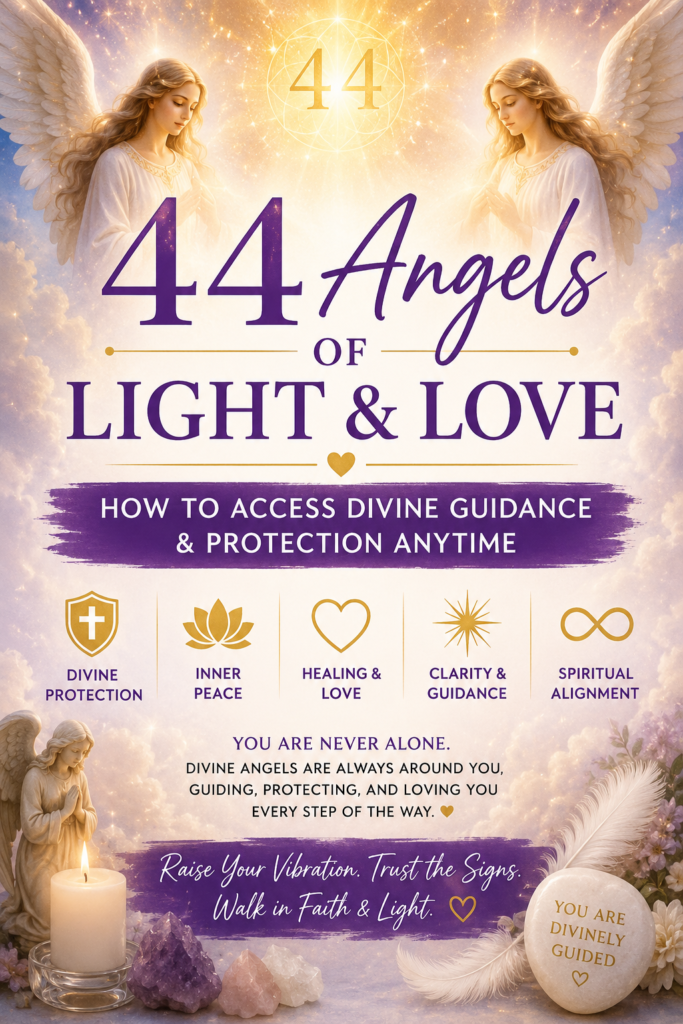
The concept of the 44 Angels of Light and Love has become increasingly popular among spiritual seekers, energy workers, meditation practitioners, and those exploring intuition and divine connection. These angels are believed to assist humanity through protection, healing, wisdom, peace, abundance, emotional support, and spiritual awakening.
The Spiritual Meaning of 44
The number 44 is considered highly significant in numerology and spiritual symbolism.
The number 4 represents:
Stability
Protection
Divine structure
Grounding
Strong foundations
When repeated as 44, this energy becomes amplified. Many people believe 44 is connected to angelic support, spiritual protection, and divine alignment.
This is why seeing:
44
4:44
repeating fours
often happens during periods of transformation, awakening, or emotional healing.
How Angels Communicate
Angelic communication is rarely loud or dramatic. Most people experience it subtly through synchronicities and intuition.
Common signs include:
Repeating angel numbers
Sudden inner knowing
Feathers appearing unexpectedly
Powerful dreams
Songs with meaningful lyrics
Chills or peaceful sensations
Sudden clarity during stressful moments
Feeling guided away from danger
Many people notice these signs more frequently when they begin meditation, prayer, journaling, gratitude practices, or spiritual reflection.
How to Connect with the Angels of Light and Love
You do not need to be psychic to connect with angelic energy.
Connection begins with openness, stillness, and intention.
Simple Angel Connection Ritual
Light a white candle
Sit quietly without distractions
Take several slow breaths
Place your hand over your heart
Say:
“I welcome divine guidance, protection, wisdom, healing, and peace into my life.”
Then remain still for several minutes.
Do not force an experience. Angelic guidance often appears naturally over time.
Raising Your Vibration
Many spiritual teachers believe angels operate through higher frequencies connected to love, peace, gratitude, compassion, and hope.
Practices that may help strengthen spiritual awareness include:
Meditation
Gratitude journaling
Prayer Breathwork
Nature walks
Healing music
Visualization
Positive affirmations
Fear contracts energy.
Love expands it.
This is why gratitude and inner peace are often described as gateways to stronger intuition.
Crystals Associated with Angelic Energy
Many spiritual practitioners use crystals during meditation and prayer.
Popular crystals linked to angelic connection include:
Selenite
Angelite
Celestite
Amethyst
Moonstone
Clear Quartz
These are often placed near meditation spaces, altars, beds, or carried throughout the day.
The Meaning of Angel Numbers
Angel numbers are believed to be symbolic messages that appear repeatedly during important moments in life.
Common interpretations include:
111 — manifestation and alignment
222 — balance and trust
333 — spiritual support
444 — protection and divine presence
555 — major change
777 — spiritual wisdom
888 — abundance and flow
When you notice repeating numbers, pay attention to your thoughts and emotions in that moment.
Angelic Protection Prayer
Many people use short prayers for energetic protection and peace.
Example:
“I ask the angels of divine light to surround me with protection, wisdom, healing, clarity, and peace. Remove negativity from my path and guide me toward my highest good.”
Visualization may strengthen the experience. Imagine white or golden light surrounding your body like a protective shield.
The 44 Angels of Light and Love remind us that spiritual support may be closer than we realize.
Whether through synchronicities, intuition, dreams, protection, or moments of peace, many believe angelic guidance quietly works behind the scenes to help us move toward healing, growth, and alignment.
The key is learning to slow down, become present, and recognize the signs.
Sometimes the universe whispers before it shouts.
And sometimes the guidance you seek has already been trying to reach you all along.
How King Solomon’s Ancient Secrets Could Change Your Life
For centuries, the name of King Solomon has been associated with wisdom, wealth, divine favor, sacred knowledge, and hidden spiritual power. Ancient traditions describe Solomon not only as a king of immense prosperity, but also as a master of sacred wisdom who understood the deeper laws of alignment, discipline, prayer, symbolism, and spiritual authority.
Today, interest in Solomon’s teachings continues to grow as more people search for ancient principles that can help them transform their mindset, strengthen their focus, and align with greater abundance and purpose.
In this article, we explore some of the most fascinating teachings connected to King Solomon and why these ancient ideas still resonate so deeply in modern spiritual and manifestation practices.
The Wisdom of King Solomon
In biblical history, King Solomon was renowned for extraordinary wisdom. His kingdom became known for prosperity, beauty, knowledge, and influence.
But beyond traditional history, many mystical traditions also associate Solomon with sacred symbols, seals, spiritual discipline, planetary timing, and ceremonial wisdom.
Ancient grimoires such as The Greater Key of Solomon and The Lesser Key of Solomon helped shape the legends surrounding Solomon’s hidden knowledge. Modern authors such as Sara L. Mastros have also explored these traditions in books like The Sorcery of Solomon, which approaches Solomonic wisdom through a spiritual and disciplined lens.
One of the most important ideas repeated throughout these traditions is this:
True power begins with inner alignment.
The Law of Correspondence
One teaching often connected to ancient wisdom traditions is the idea that the outer world reflects the inner world.
“As within, so without.”
This principle suggests that thoughts, beliefs, habits, emotional patterns, and focus eventually shape external experiences.
Whether viewed spiritually or psychologically, this concept remains powerful today. People who cultivate discipline, gratitude, clarity, and intentional focus often create more aligned outcomes in many areas of life.
The Power of the Spoken Word
Throughout many spiritual traditions, words are considered deeply powerful.
Ancient prayers, Psalms, affirmations, decrees, and sacred names were often spoken repeatedly with focused intention.
Modern manifestation practices reflect similar ideas:
affirmations
visualization
intentional self-talk
focused declarations
The principle is simple: what we consistently speak influences what we consistently believe.
And what we consistently believe influences how we act.
The Seal of Solomon
One of the most recognizable symbols associated with Solomon is the Seal of Solomon — a sacred geometric symbol formed from two interlocking triangles.
In many traditions, the symbol represents:
balance
spiritual harmony
divine alignment
union of heaven and earth
wisdom and protection
Today, sacred geometry continues to fascinate people because symbols often communicate emotionally and spiritually in ways words cannot.
For many practitioners, symbols serve as reminders of intention, focus, and spiritual connection.
Psalms, Prayer & Spiritual Alignment
Many Solomonic traditions also emphasize the use of Psalms.
Psalms such as:
Psalm 23
Psalm 91
Psalm 72
Psalm 121
have long been associated with protection, guidance, wisdom, prosperity, and divine support.
These practices were often combined with:
candles
prayer
meditation
fasting
gratitude
planetary timing
sacred oils and herbs
The purpose was not simply ritual itself, but focused alignment of mind, spirit, and intention.
Why Solomon’s Teachings Still Matter Today
Modern life often pulls people into distraction, stress, and constant noise.
Ancient systems like those connected to Solomon remind people to slow down and reconnect with:
discipline
wisdom
gratitude
intentional living
spiritual reflection
focused action
Whether someone approaches these teachings spiritually, symbolically, psychologically, or philosophically, many of the core principles remain timeless.
Wisdom matters.
Focus matters.
Discipline matters.
Gratitude matters.
And intentional action still shapes outcomes.
Perhaps the greatest secret connected to King Solomon is not hidden treasure, sacred seals, or mystical rituals.
Perhaps the greatest secret is transformation itself.
The ability to strengthen the mind… refine the spirit… develop wisdom… and align daily life with higher purpose.
Because true wealth is not only what someone possesses.
It is also who they become.
Affirmations
I align myself with wisdom and clarity.
I attract opportunities aligned with my highest good.
Have you ever walked into a room and instantly felt heavy energy… or met someone whose presence felt calming and magnetic?
According to ancient spiritual traditions, your body is more than physical. It is also energetic.
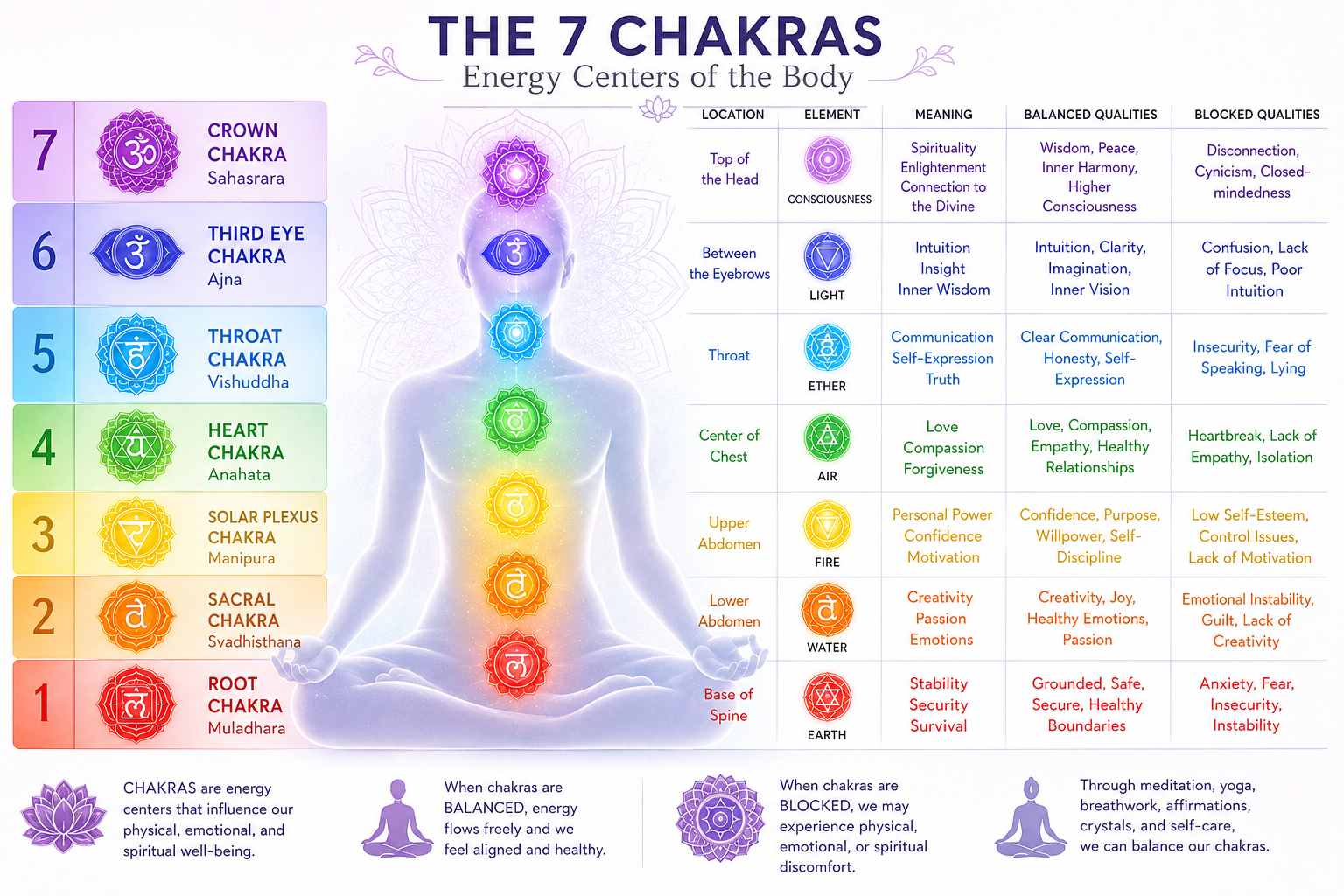
This energetic system contains powerful centers known as chakras — spinning wheels of energy believed to influence your emotions, thoughts, health, confidence, intuition, relationships, abundance, and spiritual connection.
When your chakras are balanced, energy flows freely.
When they become blocked, life can begin to feel emotionally, mentally, spiritually, and even physically out of alignment.
In this complete guide, you’ll discover:
What chakras are
The meaning of each chakra
Signs of blocked chakras
How to activate and balance them
Chakra affirmations
Foods, crystals, colors, and healing practices
Daily chakra healing rituals
Whether you are just beginning your spiritual journey or deepening your energetic practice, understanding the chakras can completely transform your life.
What Are Chakras?
The word “chakra” comes from the Sanskrit language and means “wheel” or “disk.”
Chakras are believed to be spinning centers of energy located throughout the body. Ancient Hindu and yogic traditions teach that these energy centers regulate the flow of life force energy — often called:
Prana
Chi
Qi
Universal life force energy
There are hundreds of minor chakras in the body, but seven primary chakras are most commonly discussed in spiritual and healing practices.
Each chakra corresponds to:
Specific emotions
Organs and body systems
Spiritual lessons
Mental states
Colors Frequencies
Elements
When your chakras are open and balanced, energy moves harmoniously through your system.
When blocked, symptoms may appear emotionally, spiritually, or physically.
The 7 Main Chakras
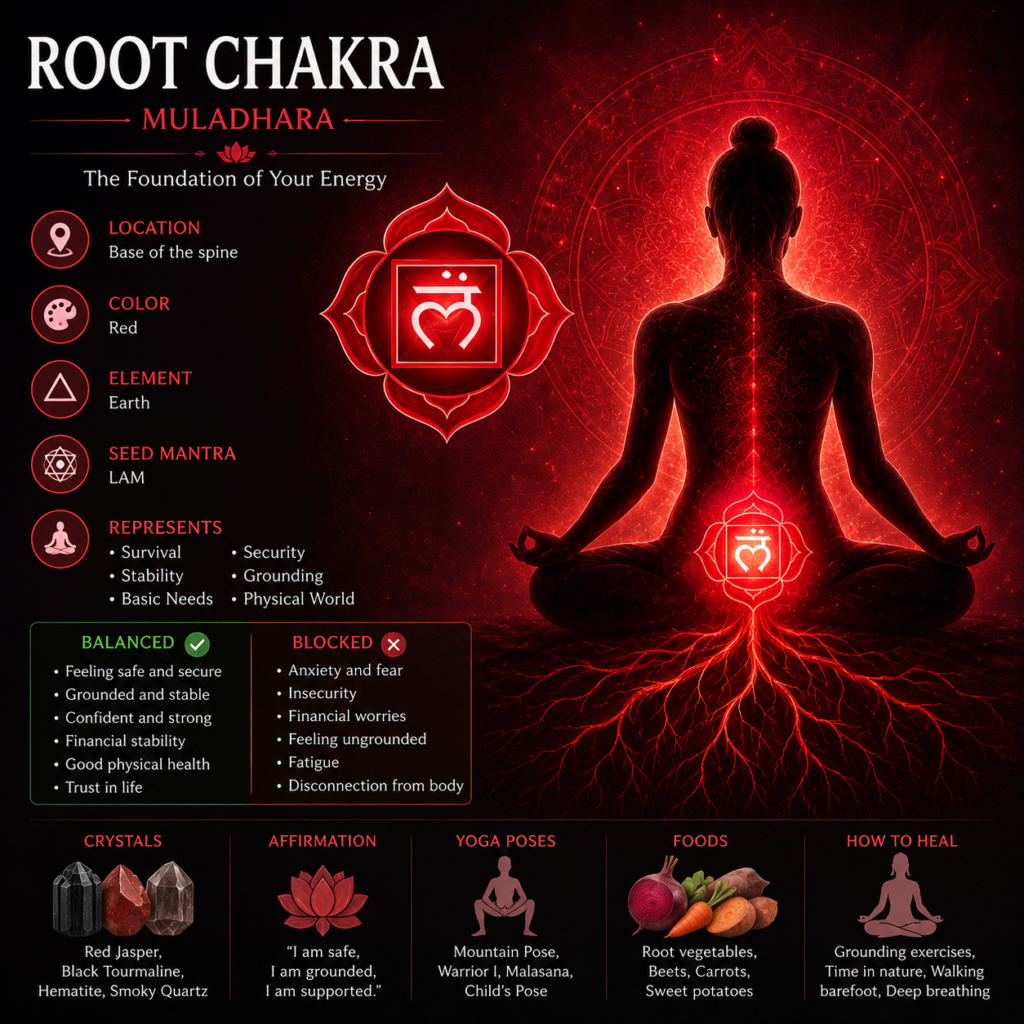
1. Root Chakra (Muladhara)
Location
Base of the spine
Color
Red
Element
Earth
Represents
Survival
Stability
Security
Grounding
Financial foundation
Balanced Root Chakra Signs
Feeling safe and protected
Confidence in life
Emotional stability
Grounded energy
Healthy boundaries
Blocked Root Chakra Signs
Anxiety
Fear
Financial insecurity
Feeling disconnected
Exhaustion
Overthinking survival issues
Healing Practices
Walking barefoot in nature
Grounding meditations
Red candle rituals
Eating root vegetables
Strength training
Breathwork
Crystals
Red Jasper
Hematite Black
Tourmaline
Smoky Quartz
Root Chakra Seed Mantra LAM
Root Chakra Affirmation
“I am safe, grounded, protected, and supported by life.”
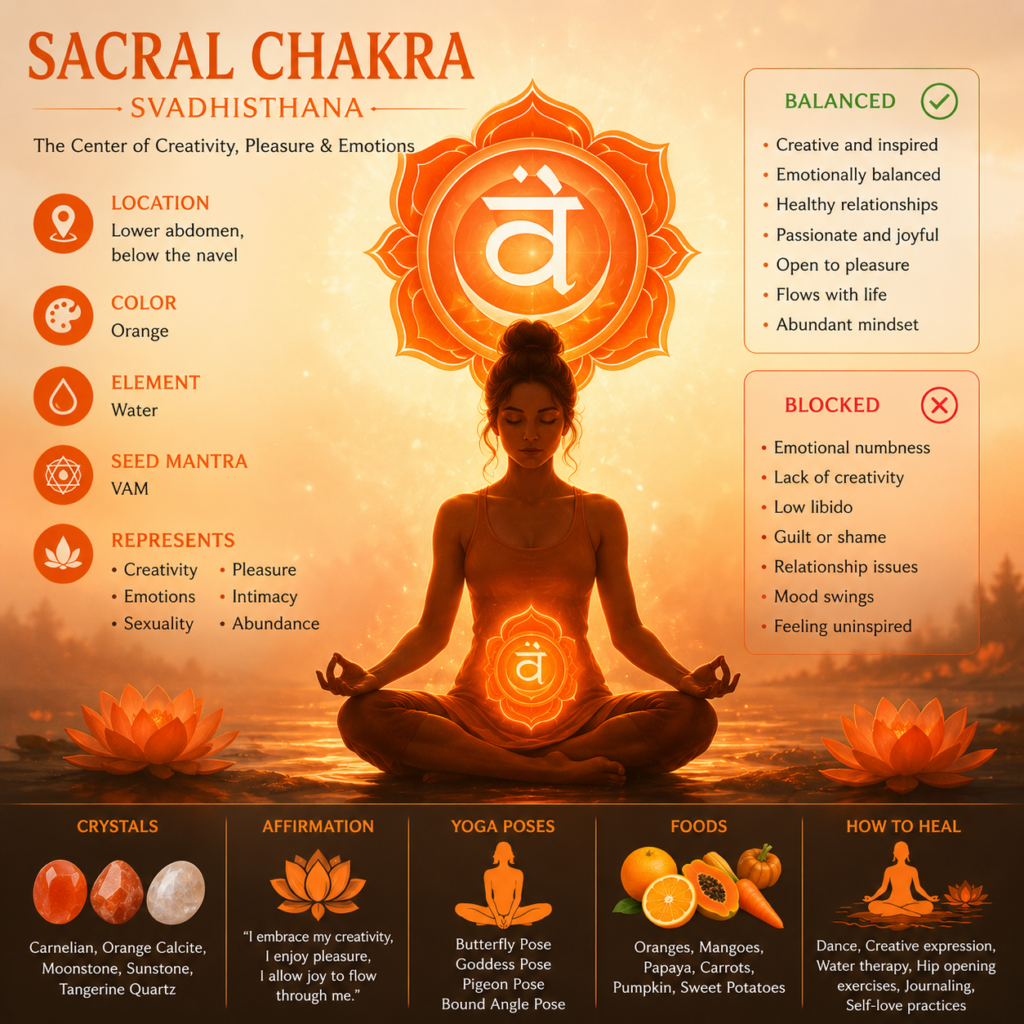
2. Sacral Chakra (Svadhisthana)
Location
Lower abdomen
Color
Orange
Element
Water
Represents
Creativity
Pleasure
Emotions
Passion
Sensuality
Emotional flow
Balanced Sacral Chakra Signs
Creativity flows easily
Healthy emotions
Joy and passion
Emotional intelligence
Inspired energy
Blocked Sacral Chakra Signs
Emotional numbness
Lack of creativity
Shame or guilt
Low passion
Relationship struggles
Healing Practices
Dancing
Creative hobbies
Water rituals
Hip-opening yoga
Emotional release journaling
Crystals
Carnelian
Orange Calcite
Moonstone
Sacral Chakra Seed Mantra VAM
Sacral Chakra Affirmation
“I allow creativity, joy, abundance, and pleasure to flow freely through me.”
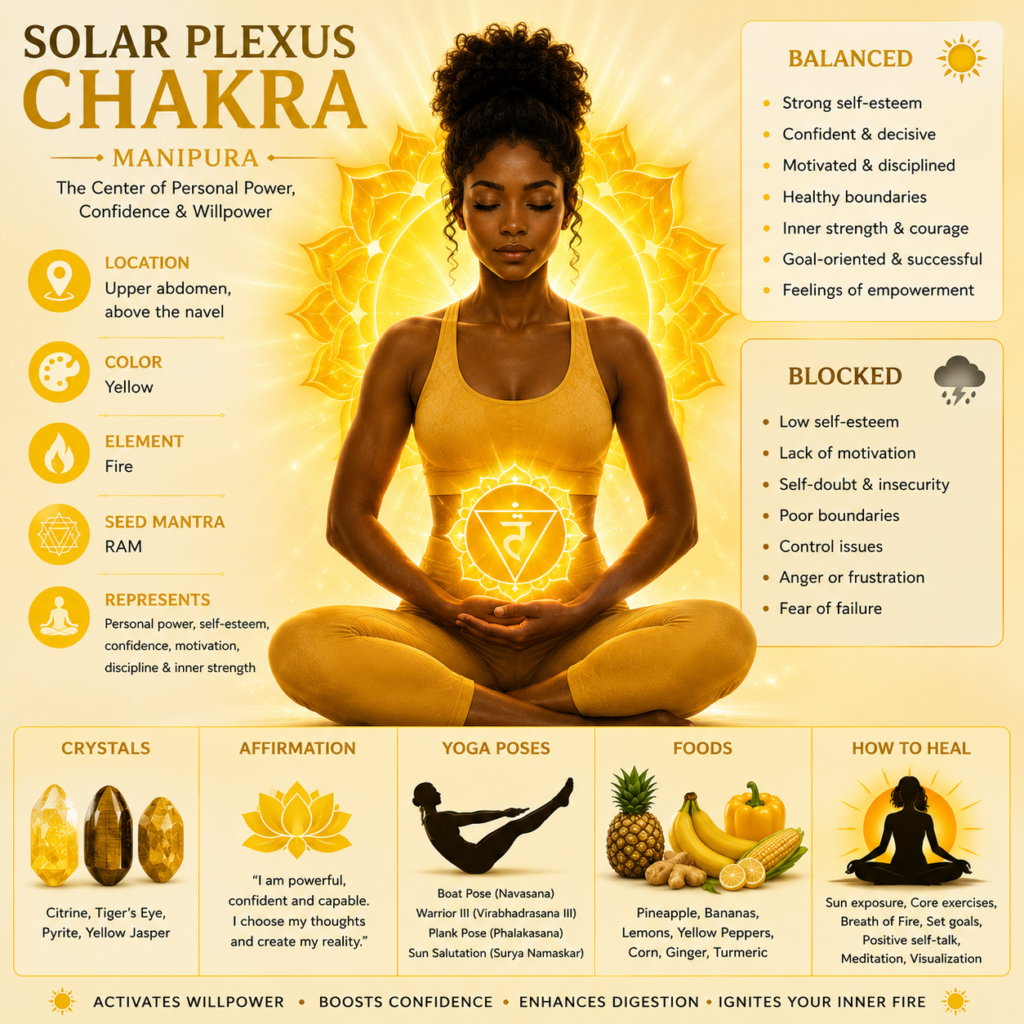
3. Solar Plexus Chakra (Manipura)
Location
Upper abdomen
Color
Yellow
Element
Fire
Represents
Confidence
Personal power
Motivation
Discipline
Self-worth
Balanced Solar Plexus Signs
Confidence
Motivation
Strong decision-making
Healthy ambition
Personal empowerment
Blocked Solar Plexus Signs
Low self-esteem
Fear of judgment
Procrastination
Lack of direction
Self-doubt
Healing Practices
Sun exposure
Goal setting
Core workouts
Fire meditations
Confidence affirmations
Crystals
Citrine
Tiger’s Eye
Pyrite
Solar Plexus Seed Mantra RAM
Solar Plexus Affirmation
“I am powerful, capable, disciplined, and worthy of success.”
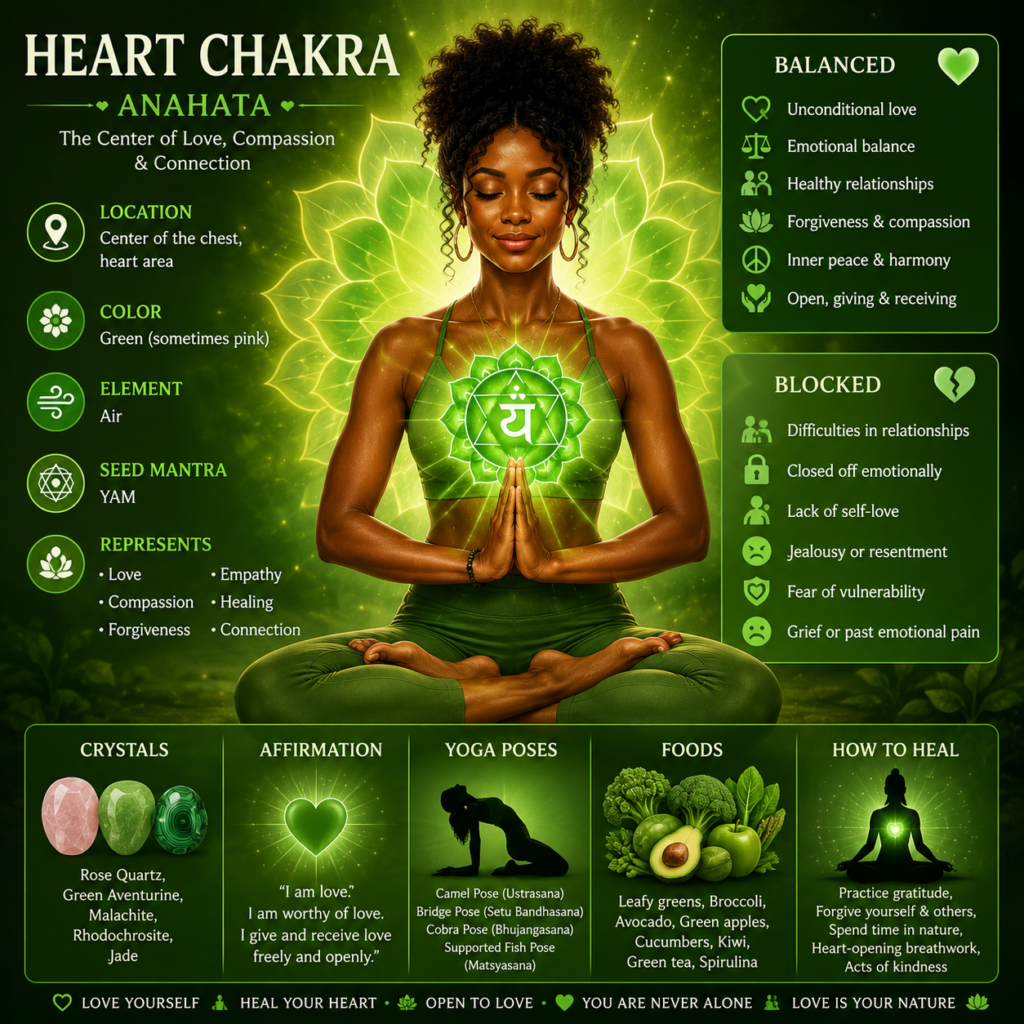
4. Heart Chakra (Anahata)
Location
Center of chest
Color
Green or Pink
Element
Air
Represents
Love
Compassion
Forgiveness
Emotional healing
Connection
Balanced Heart Chakra Signs
Healthy relationships
Compassion
Inner peace
Forgiveness
Emotional openness
Blocked Heart Chakra Signs
Emotional pain
Resentment
Isolation
Fear of vulnerability
Difficulty trusting others
Healing Practices
Gratitude journaling
Self-love rituals
Forgiveness meditations
Spending time with loved ones
Heart-opening yoga poses
Crystals
Rose Quartz
Green Aventurine
Rhodonite
Heart Seed Mantra YAM
Heart Chakra Affirmation
“I am worthy of love, healing, peace, and deep connection.”
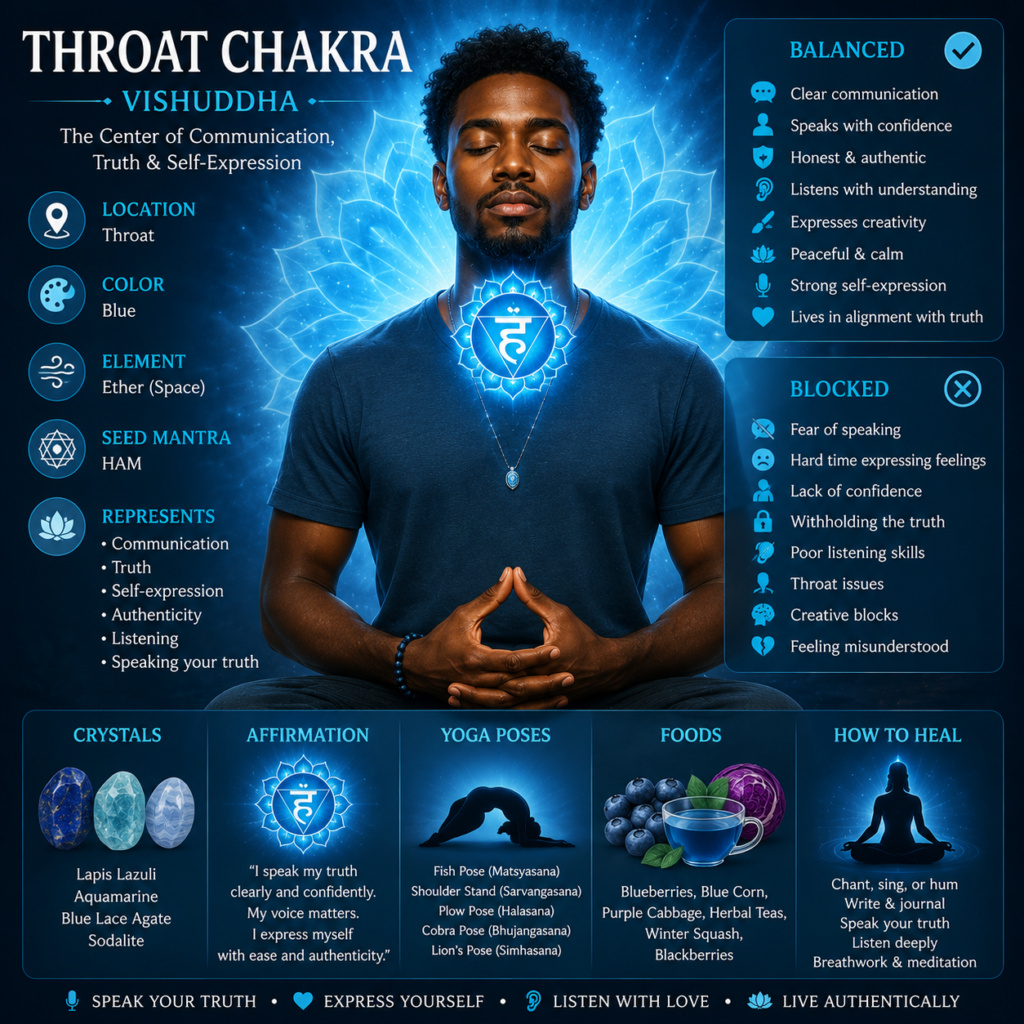
5. Throat Chakra (Vishuddha)
Location
Throat
Color
Blue
Element
Ether
Represents
Communication
Truth Self-expression
Authenticity
Balanced Throat Chakra Signs
Clear communication
Honesty
Creative expression
Confidence speaking
Blocked Throat Chakra Signs
Fear of speaking up
Social anxiety
Difficulty expressing emotions Dishonesty
Creative blocks
Healing Practices
Chanting
Singing
Journaling
Speaking affirmations aloud
Blue candle meditation
Crystals
Lapis Lazuli
Aquamarine
Blue Lace Agate
Throat Seed Mantra HAM
Throat Chakra Affirmation
“My voice matters. I express myself clearly, honestly, and confidently.”
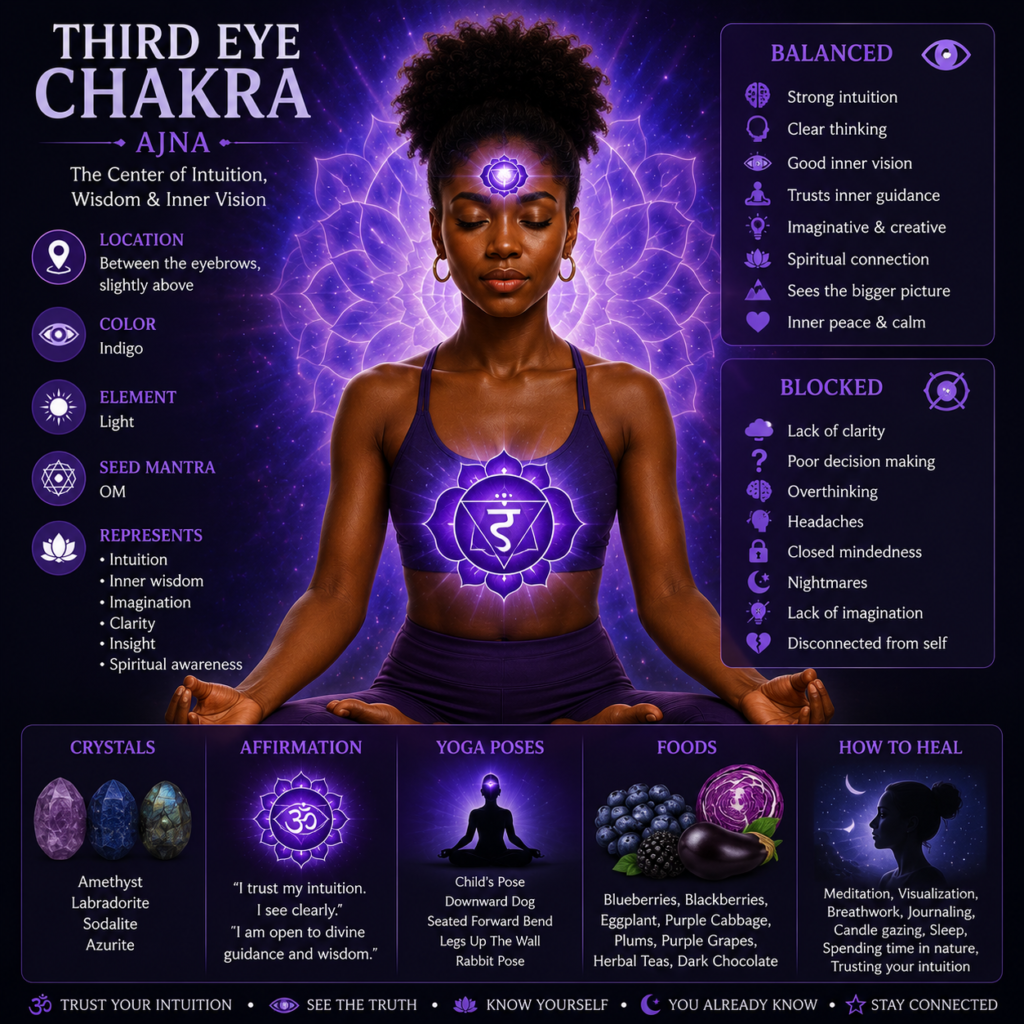
6.Third Eye Chakra (Ajna)
Location
Between the eyebrows
Color
Indigo
Element
Light
Represents
Intuition
Psychic awareness
Inner wisdom
Spiritual vision
Balanced Third Eye Signs
Strong intuition
Spiritual awareness
Mental clarity
Insightful dreams
Inner guidance
Blocked Third Eye Signs
Confusion
Lack of clarity
Overthinking
Feeling spiritually disconnected
Difficulty trusting intuition
Healing Practices
Meditation
Visualization
Dream journaling
Candle gazing
Silent reflection
Crystals
Amethyst
Labradorite
Fluorite
Third Eye Seed Mantra SHAM or OM
Third Eye Affirmation
“I trust my intuition and clearly see divine guidance unfolding before me.”
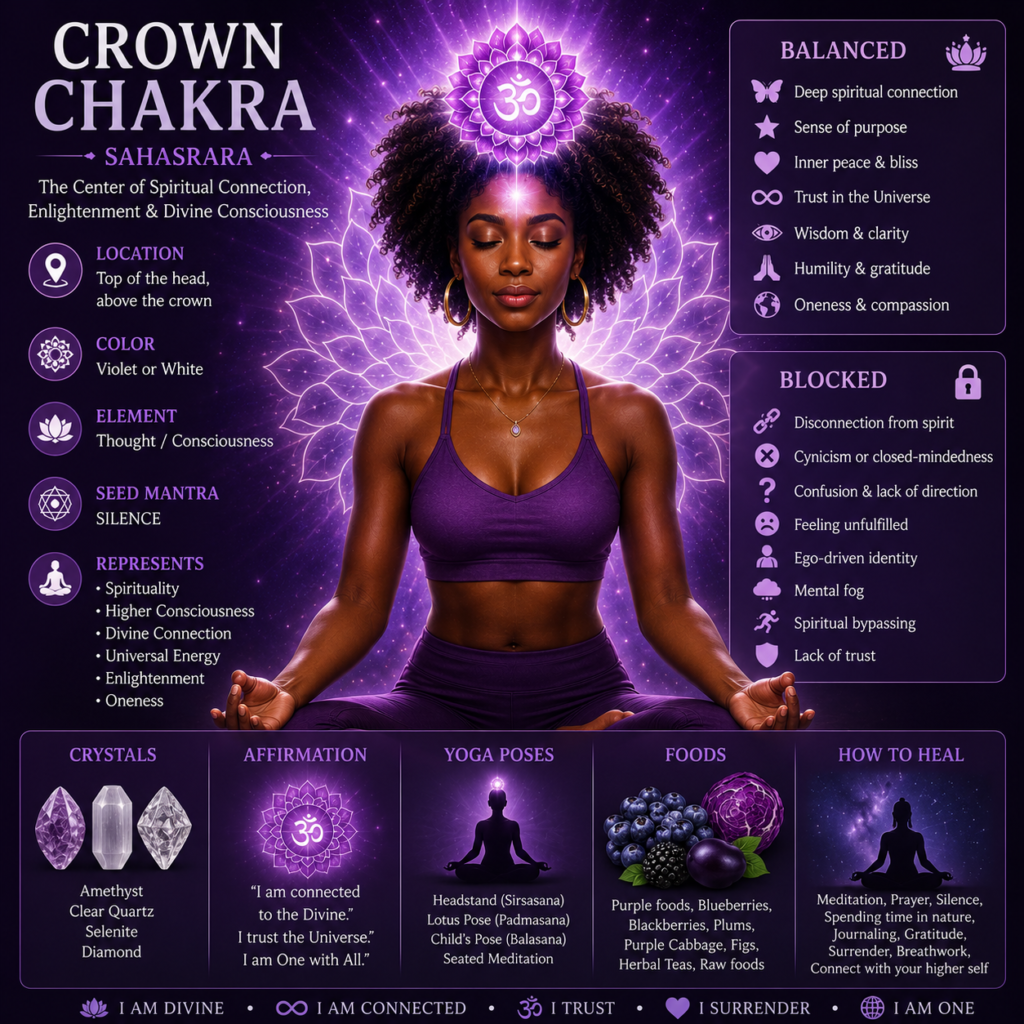
7. Crown Chakra (Sahasrara)
Location
Top of the head
Color
Violet or White
Element
Cosmic Consciousness
Represents
Spiritual connection
Enlightenment
Divine wisdom
Higher consciousness
Balanced Crown Chakra Signs
Inner peace
Spiritual connection
Trust in the universe
Wisdom Deep awareness
Blocked Crown Chakra Signs
Spiritual emptiness
Cynicism
Feeling disconnected
Lack of purpose
Healing Practices
Prayer
Meditation
Silence
Energy healing
Spending time under moonlight or sunlight
Crystals
Clear Quartz
Selenite
Amethyst
Crown Chakra Seed Mantra OM
Crown Chakra Affirmation
“I am divinely connected, guided, protected, and spiritually aligned.”
What Causes Chakra Blockages?
Chakra imbalances can happen because of:
Stress
Trauma
Negative thinking
Emotional suppression
Toxic environments
Fear
Lack of self-care
Energetic overload
Over time, blocked energy may influence your mood, confidence, motivation, and spiritual clarity.
Signs Your Chakras Need Healing
You may benefit from chakra healing if you experience:
Chronic fatigue
Emotional heaviness
Lack of motivation
Constant fear or anxiety
Difficulty manifesting goals
Feeling spiritually disconnected
Repeating toxic relationship patterns
Mental fog
Lack of inspiration
Powerful Ways to Balance Your Chakras
Meditation
Chakra meditation is one of the most powerful ways to restore energetic balance.
Visualize each chakra glowing brightly in its corresponding color.
Sound Healing
Many people use:
Singing bowls
Binaural beats
Solfeggio frequencies
Mantras
to help align the chakras energetically.
Breathwork
Deep breathing helps release stagnant emotional energy.
Yoga
Certain yoga poses activate specific chakras.
Crystals
Crystals are often used during meditation, sleep, rituals, and healing sessions.
Affirmations
Positive affirmations help shift subconscious patterns tied to each chakra.
Chakra Healing Foods
Many spiritual traditions associate foods with chakra colors.
Chakra
Foods
Root
Beets, potatoes, carrots
Sacral
Oranges, mangoes, pumpkins
Solar Plexus
Bananas, pineapple, corn
Heart
Spinach, kale, green tea
Throat
Blueberries, herbal teas
Third Eye
Purple grapes, blackberries
Crown
Light fasting, herbal infusions
Simple Daily Chakra Healing Routine
Morning
Grounding meditation
Speak chakra affirmations
Drink water mindfully
Afternoon
Spend time in sunlight
Practice conscious breathing
Eat colorful whole foods
Evening
Journal emotions
Listen to healing frequencies
Practice gratitude and forgiveness
Are Chakras Scientifically Proven?
Chakras are spiritual and energetic concepts rooted in ancient traditions.
While modern science does not officially confirm chakras as physical structures, many people report emotional, psychological, and spiritual benefits from chakra-focused practices such as meditation, mindfulness, yoga, breathwork, and energy healing.
Many practices associated with chakra work can positively affect:
Stress reduction
Emotional regulation
Relaxation
Mental clarity
Overall well-being
Your chakras are believed to reflect the energetic relationship between your mind, body, emotions, and spirit.
Healing the chakras is not about becoming perfect.
It is about becoming aligned.
The more balanced your energy becomes, the more naturally confidence, peace, clarity, creativity, intuition, love, and abundance can flow into your life.
Your energy matters.
Your thoughts matter.
Your spiritual alignment matters.
And every step you take toward healing yourself transforms not only your inner world — but the energy you bring into the world around you.
For centuries, seekers of higher wisdom have spoken about a mysterious spiritual master known as St. Germain — the guardian of transformation, freedom, abundance, and the legendary Violet Flame. Many believe St. Germain carries the power to help people release negativity, transmute lower energies, and step into a higher version of themselves.
But who exactly is St. Germain? And why are so many spiritual practitioners, manifestors, healers, and mystics turning toward his teachings today?
Let’s explore the mystical path of St. Germain and how the Violet Flame can become a powerful spiritual tool in your life.
Who Is St. Germain?
St. Germain is often described as an Ascended Master — a spiritually enlightened being who has completed the cycle of reincarnation and now guides humanity from higher realms of consciousness.
Throughout spiritual history, St. Germain has been associated with:
Spiritual freedom
Manifestation and prosperity
Divine alchemy
Transformation
Higher wisdom
Energy purification
Personal empowerment
Many legends connect him to ancient alchemy, sacred wisdom schools, hidden mystical teachings, and even miraculous acts of healing and manifestation.
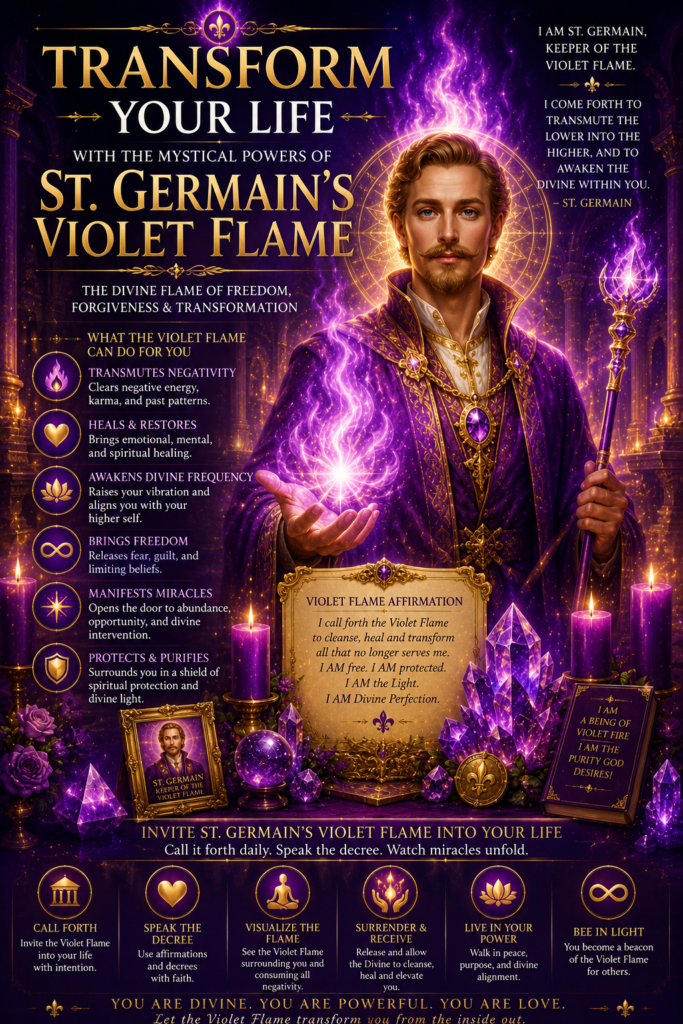
In metaphysical traditions, St. Germain is considered the keeper of the Violet Flame — a sacred spiritual energy believed to transmute negativity into light.
What Is the Violet Flame?
The Violet Flame is often described as a high-frequency spiritual fire that dissolves fear, emotional heaviness, limiting beliefs, and stagnant energy.
Unlike ordinary fire, the Violet Flame is symbolic and energetic. Spiritual practitioners use it through visualization, prayer, meditation, affirmations, and intention work.
Many people believe the Violet Flame can help:
Clear negative energy
Raise spiritual vibration
Heal emotional wounds
Release karmic patterns
Improve manifestation abilities
Increase peace and clarity
Strengthen intuition
Bring spiritual protection
The flame is associated with the color violet because violet has long symbolized transformation, spirituality, intuition, and divine connection.
Why People Work with St. Germain
People are drawn to St. Germain during periods of transformation, awakening, uncertainty, or major life changes.
You may feel called to work with St. Germain if you are:
Starting a new chapter in life
Healing from emotional pain
Trying to break negative cycles
Seeking abundance and opportunity
Deepening your spiritual practice
Looking for energetic cleansing
Wanting more confidence and empowerment
Many spiritual practitioners report feeling calmer, lighter, more focused, and spiritually aligned after consistently working with Violet Flame meditations and affirmations.
Simple Violet Flame Meditation
This beginner-friendly meditation can help you connect with the energy of transformation.
Step 1: Create a Calm Space
Sit comfortably in a quiet location. Light a candle if desired and take several deep breaths.
Step 2: Visualize the Violet Flame
Imagine a brilliant violet light surrounding your body like a sacred fire. See it flowing through your mind, heart, emotions, and energy field.
Step 3: Release Heavy Energy
As the flame surrounds you, imagine stress, fear, anger, sadness, and negativity dissolving into light.
Step 4: Speak an Affirmation
Repeat slowly:
“I am purified by the Violet Flame.” “I release all energies that no longer serve me.” “I welcome peace, abundance, healing, and divine transformation.”
Step 5: Sit in Stillness
Remain in the visualization for several minutes while breathing deeply and allowing yourself to feel calm and renewed.
Signs You May Be Experiencing Spiritual Transformation
After working with St. Germain and the Violet Flame, some people notice:
Increased intuition
Emotional release
Stronger dreams
Feeling lighter emotionally
Sudden clarity about life situations
Desire to change habits or environments
Greater sense of peace
Increased synchronicities
Transformation often begins internally before external life changes appear.
Crystals Associated with St. Germain
Many practitioners combine crystal energy with Violet Flame work.
Popular crystals include:
Amethyst
Charoite
Lepidolite
Clear Quartz
Fluorite
Sugilite
Amethyst is especially connected to spiritual protection, intuition, and higher consciousness.
Herbs and Incense for Violet Flame Rituals
You can enhance your spiritual practice with cleansing herbs and incense such as:
Lavender
Mugwort
Frankincense
Myrrh
Sage
Rosemary
Always use herbs and incense responsibly and safely.
A Simple Violet Flame Prayer
“Beloved St. Germain, surround me with the sacred Violet Flame. Purify my mind, body, spirit, and energy. Remove fear, negativity, and limitation from my path. Help me align with peace, wisdom, abundance, and divine transformation. May I walk forward renewed, empowered, and spiritually protected. And so it is.”
Final Thoughts
The teachings of St. Germain and the Violet Flame continue to inspire spiritual seekers around the world because they focus on one powerful truth: transformation is always possible.
No matter what challenges you have faced, you have the ability to release old energy, raise your vibration, and create a new reality aligned with peace, abundance, healing, and purpose.
Whether you use prayer, meditation, affirmations, crystals, or visualization, the journey with St. Germain can become a powerful spiritual practice for inner growth and awakening.
The Violet Flame reminds us that even darkness can be transformed into light.